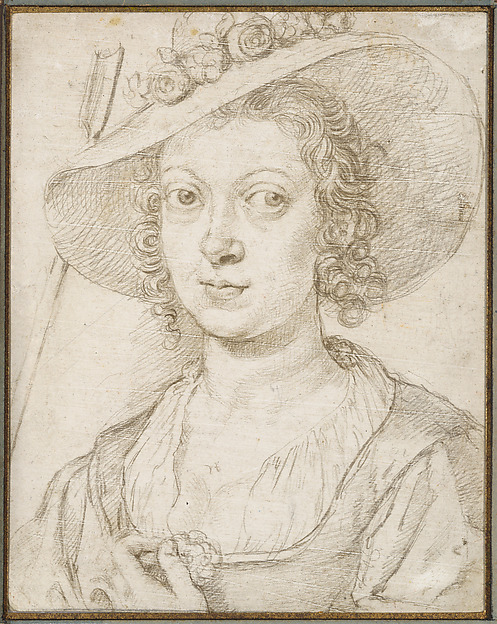
Portrait of a woman as a shepherdess
✦ Read about this
This tiny portrait — barely larger than a business card — was drawn in metalpoint, a demanding technique in which the artist works with a metal stylus on a specially prepared surface, leaving marks that cannot be erased. De Passe drew on prepared parchment forming a small writing tablet, or tafelet, later inset into a painted mount made in the nineteenth century.
Crispijn de Passe the Younger (ca. 1594–1670) belonged to the prolific Van de Passe family of printmakers. He worked as an engraver, draughtsman, and print publisher during the Dutch Golden Age, and was the son of Crispijn van de Passe the Elder. Born in Cologne, he died in Amsterdam.
The drawing, made about 1635–40, portrays a woman in the guise of a shepherdess, a pastoral role popular in Dutch portraiture of the period. It entered the Metropolitan Museum in 2024 through the Frits and Rita Markus Fund.
Background drawn from The Met & Wikipedia
Today's poem
Lines Written In Early Spring
I heard a thousand blended notes, While in a grove I sate reclined, In that sweet mood when pleasant thoughts Bring sad thoughts to the mind. To her fair works did Nature link The human soul that through me ran; And much it grieved my heart to think What man has made of man. Through primrose tufts, in that green bower, The periwinkle trailed its wreaths; And 'tis my faith that every flower Enjoys the air it breathes. The birds around me hopped and played, Their thoughts I cannot measure:-- But the least motion which they made It seemed a thrill of pleasure. The budding twigs spread out their fan, To catch the breezy air; And I must think, do all I can, That there was pleasure there. If this belief from heaven be sent, If such be Nature's holy plan, Have I not reason to lament What man has made of man?
William Wordsworth · Public domain
✦ Read about this
William Wordsworth was an English Romantic poet who, together with Samuel Taylor Coleridge, helped launch the Romantic Age in English literature with their joint publication Lyrical Ballads (1798). "Lines Written in Early Spring" appeared in that volume.
The poem is built from six quatrains in a plain, ballad-like measure, its diction deliberately simple. The speaker sits reclined in a grove, taking pleasure in the birds, flowers, and budding twigs around him, and extends his sense of enjoyment to the natural world itself — asserting his "faith that every flower / Enjoys the air it breathes."
That happiness, however, is shadowed by a recurring lament. The pleasant scene brings "sad thoughts to the mind," prompting the speaker to grieve over "what man has made of man." Nature's evident harmony becomes a measure against which human conduct falls short, and the poem closes by returning to that contrast as a question.
Background drawn from PoetryDB & Wikipedia