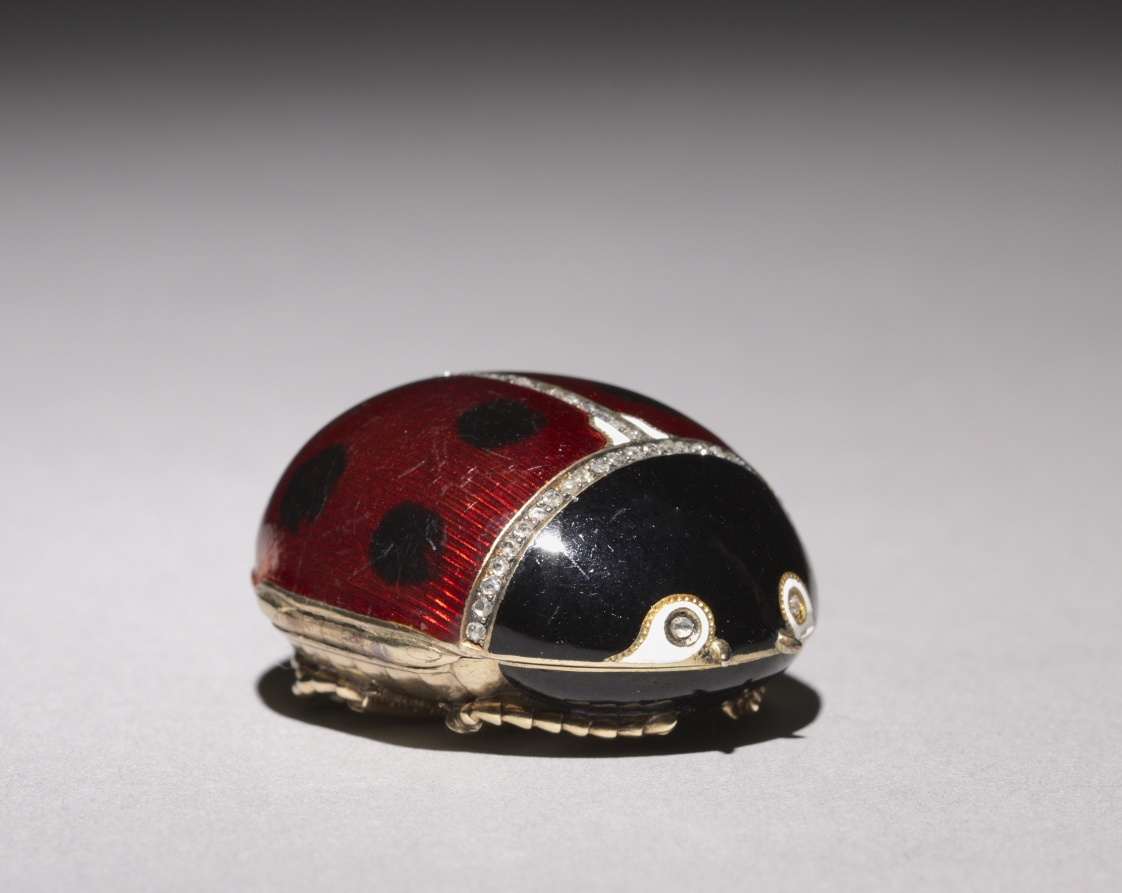
Ladybird Beetle Pillbox
✦ Read about this
This pillbox in the form of a ladybird beetle came from the House of Fabergé, the jewellery firm founded in 1842 in Saint Petersburg by Gustav Fabergé. The work bears the mark of Mikhail Perkhin (1860–1903), one of Fabergé's principal workmasters, who oversaw production during the years this box was made, 1896–1903.
Barely five centimeters long, the box is worked in gold, enamel, and diamonds, its beetle shape realized in the enameled and jeweled techniques for which the firm became known. It belongs to the tradition of small luxury objects—rather than large jewelry—that made Fabergé's reputation among Russian and European patrons.
The pillbox is part of the India Early Minshall Collection at the Cleveland Museum of Art, given in 1966.
Background drawn from Cleveland Museum of Art & Wikipedia
Today's poem
Happy Is England! I Could Be Content
Happy is England! I could be content To see no other verdure than its own; To feel no other breezes than are blown Through its tall woods with high romances blent; Yet do I sometimes feel a languishment For skies Italian, and an inward groan To sit upon an Alp as on a throne, And half forget what world or worldling meant. Happy is England, sweet her artless daughters; Enough their simple loveliness for me, Enough their whitest arms in silence clinging; Yet do I often warmly burn to see Beauties of deeper glance, and hear their singing, And float with them about the summer waters.
John Keats · Public domain
✦ Read about this
John Keats, an English poet of the second generation of Romantics alongside Byron and Shelley, published poetry for less than four years before dying of tuberculosis at 25. His work was received indifferently in his lifetime, but his reputation grew quickly after his death; by the end of the nineteenth century he was firmly placed in the canon of English literature and strongly influenced the Pre-Raphaelite Brotherhood.
"Happy Is England! I Could Be Content" is a sonnet built on a repeated turn: each of its two movements begins by praising England — its greenery, woods, and "artless daughters" — before admitting a countervailing longing. The poet confesses that he "sometimes" wishes for Italian skies and Alpine heights, and "often" burns to see beauties of "deeper glance."
The poem sets a settled contentment with home against a restless attraction to the foreign and the more intense, holding both feelings in balance rather than resolving them.
Background drawn from PoetryDB & Wikipedia