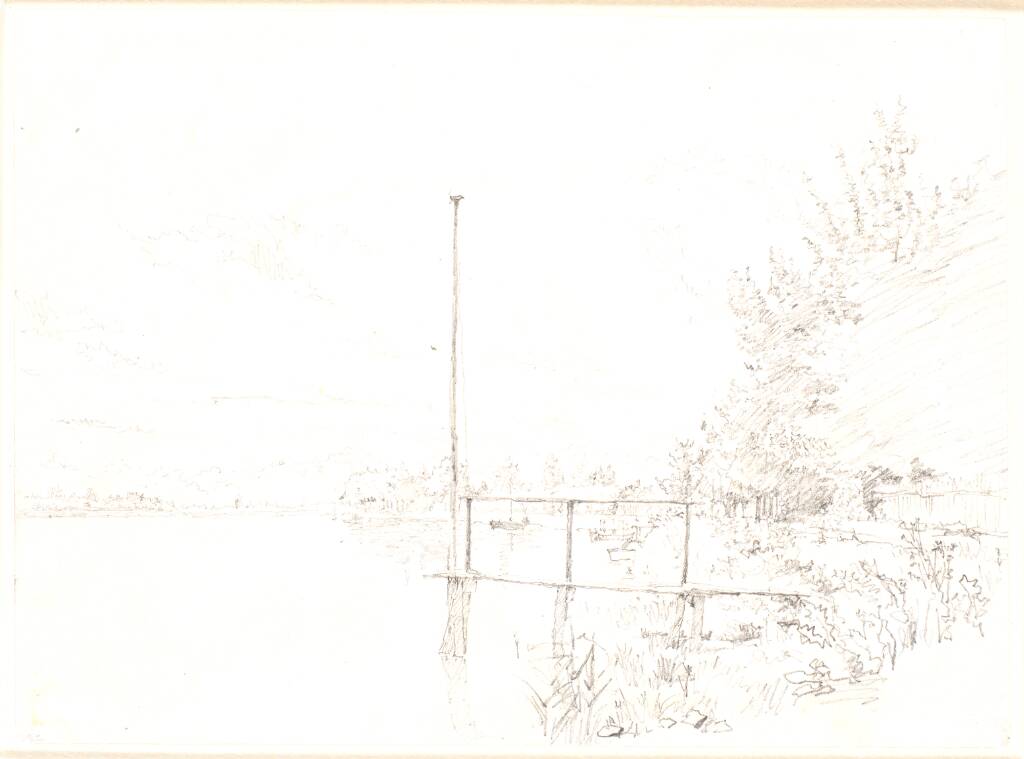
Udsigt fra Dosseringen ved Sortedamssøen mod Nørrebro
✦ Read about this
Christen Købke drew this view from the Dosseringen embankment along Sortedamssøen, looking toward Nørrebro, in 1836–1837. It is a pencil drawing (blyant) now in the collection of the National Gallery of Denmark (SMK).
Købke (1810–1848) was among the leading figures of the Golden Age of Danish Painting. He returned repeatedly to the lakes and surroundings north of Copenhagen near his home, and the Sortedamssøen area supplied motifs for a number of his paintings and drawings.
As a preparatory or independent work on paper, the sheet records the local topography in graphite, a medium suited to the careful observation that characterizes his approach to familiar, everyday Danish settings.
Background drawn from SMK — National Gallery of Denmark & Wikipedia
Today's poem
The Road Not Taken
Two roads diverged in a yellow wood, And sorry I could not travel both And be one traveler, long I stood And looked down one as far as I could To where it bent in the undergrowth; Then took the other, as just as fair, And having perhaps the better claim, Because it was grassy and wanted wear; Though as for that the passing there Had worn them really about the same,
Robert Frost · 1916 · Public domain
✦ Read about this
Robert Frost (1874–1963) was an American poet known for his realistic depictions of rural life and his command of American colloquial speech. He frequently set his poems in early twentieth-century rural New England, using those landscapes to examine complex social and philosophical themes.
"The Road Not Taken" is among his most widely read poems. It describes a traveler standing where two roads diverge in a wood, unable to take both, who chooses one and reflects on the choice. The poem is often read as a straightforward celebration of individualism, but its details complicate that reading: the speaker admits the two roads were worn "really about the same," undercutting the sense that one was truly less traveled.
The poem is written in iambic tetrameter, arranged in stanzas of five lines. Its plain diction and conversational tone are characteristic of Frost's style, drawing philosophical weight from an ordinary rural scene.
Background drawn from curated & Wikipedia