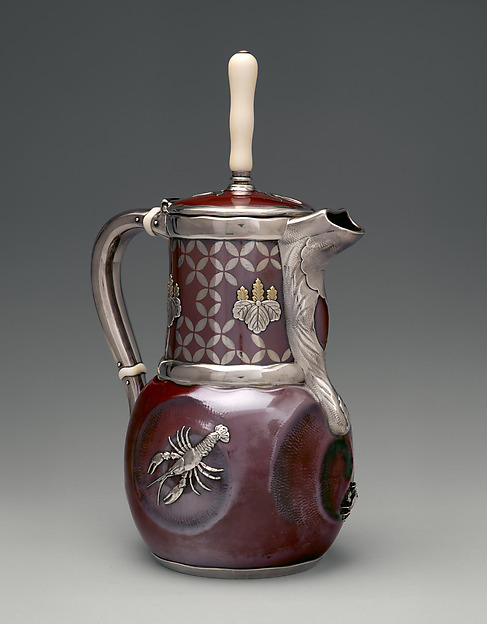
Chocolate Pot
✦ Read about this
This chocolate pot, made by Tiffany & Co. in 1879, combines silver with patinated copper, gold, and ivory — a mixed-metal approach that reflects the firm's interest in Japanese metalworking techniques during this period. The layering and coloration of different metals departed sharply from conventional monochrome silver holloware.
Tiffany & Co., founded in New York in 1837, was by the late 1870s established as a leading American maker of luxury silver and jewelry. Its designers in this era drew on East Asian sources, part of a broader wave of Japonisme that shaped Western decorative arts after Japan reopened to international trade.
The pot stands roughly 11 5/8 inches high. It entered the Metropolitan Museum of Art's American Wing in 2017, acquired through gifts from the Louis and Virginia Clemente Foundation and Emma and Jay A. Lewis.
Background drawn from The Met & Wikipedia
Today's poem
Spring Quiet
Gone were but the Winter, Come were but the Spring, I would go to a covert Where the birds sing; Where in the whitethorn Singeth a thrush, And a robin sings In the holly-bush. Full of fresh scents Are the budding boughs Arching high over A cool green house: Full of sweet scents, And whispering air Which sayeth softly: "We spread no snare; "Here dwell in safety, Here dwell alone, With a clear stream And a mossy stone. "Here the sun shineth Most shadily; Here is heard an echo Of the far sea, Though far off it be."
Christina Rossetti · Public domain
✦ Read about this
Christina Rossetti (1830–1894, though only her general profile is recorded here) was an English writer of romantic and devotional poems. She is best known for "Goblin Market" and "Remember," and "Spring Quiet" belongs to the same body of lyric work.
The poem imagines an escape from winter into a secluded natural retreat where birds sing among whitethorn, holly, and budding boughs. Its short lines and simple rhymes give it a songlike, understated quality. The speaker longs for a "covert" that offers seclusion and safety, a place set apart from threat.
In its closing stanzas the whispering air itself speaks, promising a refuge free of snares where one may "dwell in safety" and "dwell alone." The final image of an echo "of the far sea," heard even at a distance, extends the small enclosed scene outward, linking the quiet retreat to a wider world beyond it.
Background drawn from PoetryDB & Wikipedia