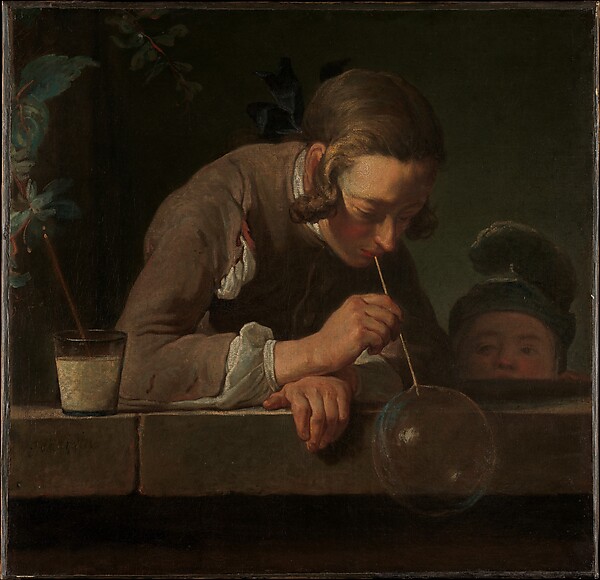
Soap Bubbles
✦ Read about this
Chardin, best known for still lifes of kitchen tables and domestic objects, here turned to a figure subject: a young man leaning from a window, absorbed in blowing a soap bubble while a small child watches. The soap bubble was a common emblem of transience—a reminder of the brevity of life—giving an everyday amusement a moralizing undertone.
The painting was made in Paris around 1733–34, a moment when Chardin (1699–1779) was expanding from still life into genre scenes of ordinary people and pastimes. It shows the qualities that define his work: a carefully balanced composition, softly diffused light, and a granular, built-up handling of paint.
The canvas is roughly square, about 61 by 63 centimeters. It entered The Metropolitan Museum of Art in 1949 through the Wentworth Fund and is held in the Department of European Paintings.
Background drawn from The Met & Wikipedia
Today's poem
The Little Boy Found
The little boy lost in the lonely fen, Led by the wandering light, Began to cry, but God, ever nigh, Appeared like his father, in white. He kissed the child, and by the hand led, And to his mother brought, Who in sorrow pale, through the lonely dale, The little boy weeping sought.
William Blake · Public domain
✦ Read about this
William Blake was an English poet, painter and printmaker who went largely unrecognised in his lifetime but became a central figure of the Romantic Age. He produced a symbolically rich body of work in which he embraced the imagination as "the body of God," or "human existence itself." The 20th-century critic Northrop Frye described his "prophetic works" as the least read poetry in the language relative to their merit.
"The Little Boy Found" is a short two-stanza lyric that resolves the situation of its companion poem: a child lost in a fen and misled by a "wandering light" is rescued when God appears, "like his father, in white," and returns him to his grieving mother.
The poem turns on plain images—the lonely fen, the pale sorrowing mother, the white-clad divine figure—to enact a movement from fear and abandonment to reunion and divine care.
Background drawn from PoetryDB & Wikipedia