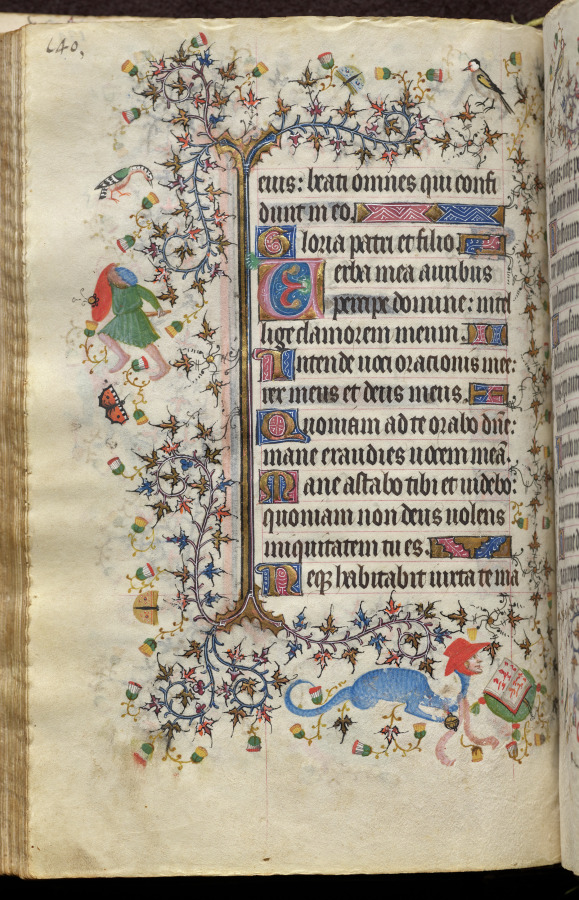
Hours of Charles the Noble, King of Navarre (1361-1425): fol. 70v, Text
✦ Read about this
This precious volume was obviously highly prized by its owner, the French-born King of Navarre, who had his coat of arms painted on no less than twenty folios. Rather than directly commissioning this manuscript from a specific workshop, it seems that Charles the Noble acquired his book of hours -- perhaps ready-made for the luxury market -- while on a trip to Paris in 1404-05. A collaborative effort, six painting styles are evidenced within the pages of this codex, those of two Italians, two Frenchmen, and two Netherlanders. The painter who was responsible for the planning and decoration of the book, and who produced seventeen of the large miniatures, was a Bolognese artist known as the Master of the Brussels Initials. His principal assistant, responsible for most of the borders, was a Florentine who signed his name "Zecho" da Firenze on folio 208 verso.
Background drawn from Cleveland Museum of Art
Today's poem
To Ireland
Bear witness, Erin! when thine injured isle Sees summer on its verdant pastures smile, Its cornfields waving in the winds that sweep The billowy surface of thy circling deep! Thou tree whose shadow o'er the Atlantic gave Peace, wealth and beauty, to its friendly wave, its blossoms fade, And blighted are the leaves that cast its shade; Whilst the cold hand gathers its scanty fruit, Whose chillness struck a canker to its root. I could stand Upon thy shores, O Erin, and could count The billows that, in their unceasing swell, Dash on thy beach, and every wave might seem An instrument in Time the giant's grasp, To burst the barriers of Eternity. Proceed, thou giant, conquering and to conquer; March on thy lonely way! The nations fall Beneath thy noiseless footstep; pyramids That for millenniums have defied the blast, And laughed at lightnings, thou dost crush to nought. Yon monarch, in his solitary pomp, Is but the fungus of a winter day That thy light footstep presses into dust. Thou art a conqueror, Time; all things give way Before thee but the 'fixed and virtuous will'; The sacred sympathy of soul which was When thou wert not, which shall be when thou perishest. ...
Percy Bysshe Shelley · Public domain
✦ Read about this
Percy Bysshe Shelley (1792–1822) was an English Romantic poet who was a radical in his political and social views as well as in his verse. He achieved little fame in his lifetime, but his reputation grew steadily after his death, and he became an important influence on later poets including Robert Browning, Algernon Charles Swinburne, Thomas Hardy, and W. B. Yeats. Harold Bloom described him as "a superb craftsman, a lyric poet without rival, and surely one of the most advanced sceptical intellects ever to write a poem."
"To Ireland" addresses Ireland ("Erin") as an injured island whose beauty and prosperity have been blighted by a "cold hand." The poem then turns to a meditation on Time, imagined as a giant who crushes pyramids and monarchs alike, before which all things yield—except the "fixed and virtuous will" and the "sacred sympathy of soul," which precede and outlast Time itself.
Background drawn from PoetryDB & Wikipedia