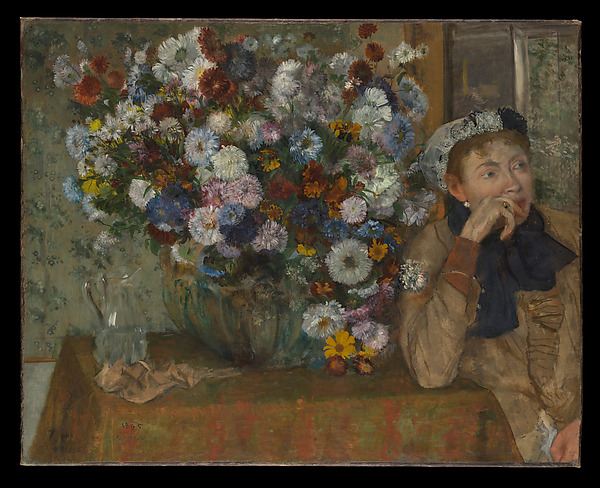
A Woman Seated beside a Vase of Flowers (Madame Paul Valpinçon?)
✦ Read about this
The unusual feature of this painting is its composition: the sitter is pushed to the right edge, while a large, overflowing arrangement of flowers dominates the center and left. Degas titled it *A Woman Seated beside a Vase of Flowers*, subordinating the human subject to the still life. The identity of the woman is uncertain, possibly Madame Paul Valpinçon.
Edgar Degas (1834–1917), born and died in Paris, is best known as an Impressionist working in oil and pastel. He painted this work in 1865, an early point in his career, in oil on canvas measuring roughly 74 by 93 cm.
The painting entered the collection of the Metropolitan Museum of Art through the H. O. Havemeyer Collection, bequeathed by Mrs. H. O. Havemeyer in 1929, and is held in the Department of European Paintings.
Background drawn from The Met & Wikipedia
Today's poem
Great Streets of silence led away
Great Streets of silence led away To Neighborhoods of Pause -- Here was no Notice -- no Dissent No Universe -- no laws -- By Clocks, 'twas Morning, and for Night The Bells at Distance called -- But Epoch had no basis here For Period exhaled.
Emily Dickinson · Public domain
✦ Read about this
Emily Dickinson (American, 1830–1886) published almost nothing during her lifetime and was largely unknown as a poet; her work is now regarded as canonical. The Poetry Foundation credits her with creating "a distinctively elliptical language for expressing what was possible but not yet realized" — a description this poem bears out.
The two quatrains describe a place emptied of the usual coordinates of existence: no notice, no dissent, no universe, no laws. The imagery of streets and neighborhoods gives spatial form to an abstraction — a "silence" and "Pause" that suspend ordinary reality.
The poem's central concern is the collapse of time and measure. Clocks and bells still mark morning and night, but they lose their meaning here, where "Epoch had no basis" and "Period exhaled." Dickinson's characteristic dashes, capitalization, and compressed syntax enact the very suspension of order the poem describes.
Background drawn from PoetryDB & Wikipedia