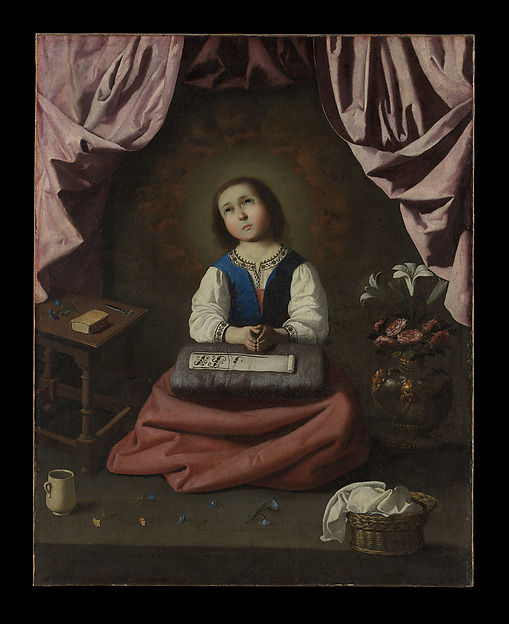
The Young Virgin
✦ Read about this
Francisco de Zurbarán (1598–1664) earned the nickname "Spanish Caravaggio" for his forceful use of chiaroscuro—the dramatic contrast of light and shadow visible in this canvas, where the child appears illuminated against a darkened ground. Working primarily in Seville, he specialized in religious subjects, particularly monks, nuns, and martyrs, alongside still-lifes.
*The Young Virgin* was painted around 1632–33, in oils on a canvas measuring roughly 117 by 94 cm. It depicts Mary as a child, a devotional subject popular in Spanish Counter-Reformation art.
The painting entered The Metropolitan Museum of Art in 1927 through the Fletcher Fund and is held in the Department of European Paintings.
Background drawn from The Met & Wikipedia
Today's poem
Adieu to a Soldier.
ADIEU, O soldier! You of the rude campaigning, (which we shared,) The rapid march, the life of the camp, The hot contention of opposing fronts—the long manoeuver, Red battles with their slaughter,—the stimulus—the strong, terrific game, Spell of all brave and manly hearts—the trains of Time through you, and like of you, all fill’d, With war, and war’s expression. Adieu, dear comrade! Your mission is fulfill’d—but I, more warlike, Myself, and this contentious soul of mine, Still on our own campaigning bound, Through untried roads, with ambushes, opponents lined, Through many a sharp defeat and many a crisis—often baffled, Here marching, ever marching on, a war fight out—aye here, To fiercer, weightier battles give expression.
Walt Whitman · Public domain
✦ Read about this
Walt Whitman (1819–1892) was an American poet, essayist, and journalist, often called the father of free verse and considered one of the most influential poets in American and world literature. His writing combined transcendentalism and realism, and was controversial in his time; his 1855 collection *Leaves of Grass* was described by some as obscene for its overt sensuality.
"Adieu to a Soldier" bids farewell to a comrade of "the rude campaigning," recalling the shared experience of war—the marches, camps, and "red battles with their slaughter." The soldier's mission is fulfilled, but the speaker turns the military imagery inward, declaring himself "more warlike" and still bound on his own campaign along "untried roads," through defeat and crisis, toward "fiercer, weightier battles."
Written in Whitman's characteristic free verse, the poem transforms the language of soldiering into a metaphor for the ongoing struggle of the "contentious soul," extending the farewell from literal war into a lifelong internal contest.
Background drawn from PoetryDB & Wikipedia