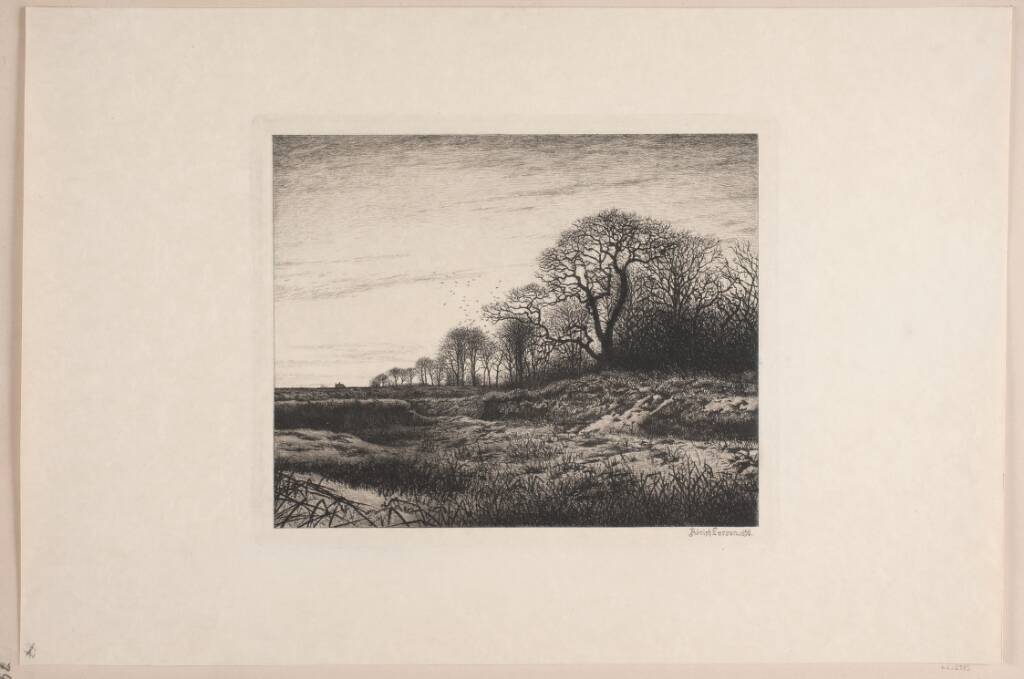
Februaraften
✦ Read about this
Februaraften ("February Evening") is an etching made by Adolph Larsen in 1898. The choice of etching—a printmaking technique in which lines are bitten into a metal plate with acid before inking and printing—allows for the fine gradations of tone suited to a nocturnal winter subject.
The work is held by the SMK, the National Gallery of Denmark in Copenhagen. It dates from the late nineteenth century, a period when etching was widely revived among printmakers across Europe as an artistic medium in its own right rather than a purely reproductive one.
Background drawn from SMK — National Gallery of Denmark
Today's poem
Otho
Thou wert not, Cassius, and thou couldst not be, Last of the Romans, though thy memory claim From Brutus his own glory--and on thee Rests the full splendour of his sacred fame: Nor he who dared make the foul tyrant quail Amid his cowering senate with thy name, Though thou and he were great--it will avail To thine own fame that Otho's should not fail. 'Twill wrong thee not--thou wouldst, if thou couldst feel, Abjure such envious fame--great Otho died Like thee--he sanctified his country's steel, At once the tyrant and tyrannicide, In his own blood--a deed it was to bring Tears from all men--though full of gentle pride, Such pride as from impetuous love may spring, That will not be refused its offering.
Percy Bysshe Shelley · Public domain
✦ Read about this
Percy Bysshe Shelley, one of the major English Romantic poets, wrote as a radical in both his verse and his political and social views. He achieved little fame during his lifetime, but his reputation grew steadily after his death, and he influenced later poets including Robert Browning, Swinburne, Thomas Hardy, and W. B. Yeats. Harold Bloom called him "a superb craftsman, a lyric poet without rival, and surely one of the most advanced sceptical intellects ever to write a poem."
"Otho" turns to Roman history and its politics of tyranny and tyrannicide. It addresses Cassius, whom it declines to name the "last of the Romans," insisting instead that his fame rests alongside that of Brutus. The poem then holds up the emperor Otho, who died by his own hand, as "at once the tyrant and tyrannicide," sanctifying his country's cause in his own blood.
The poem is built from two eight-line stanzas of largely interlocking rhyme.
Background drawn from PoetryDB & Wikipedia