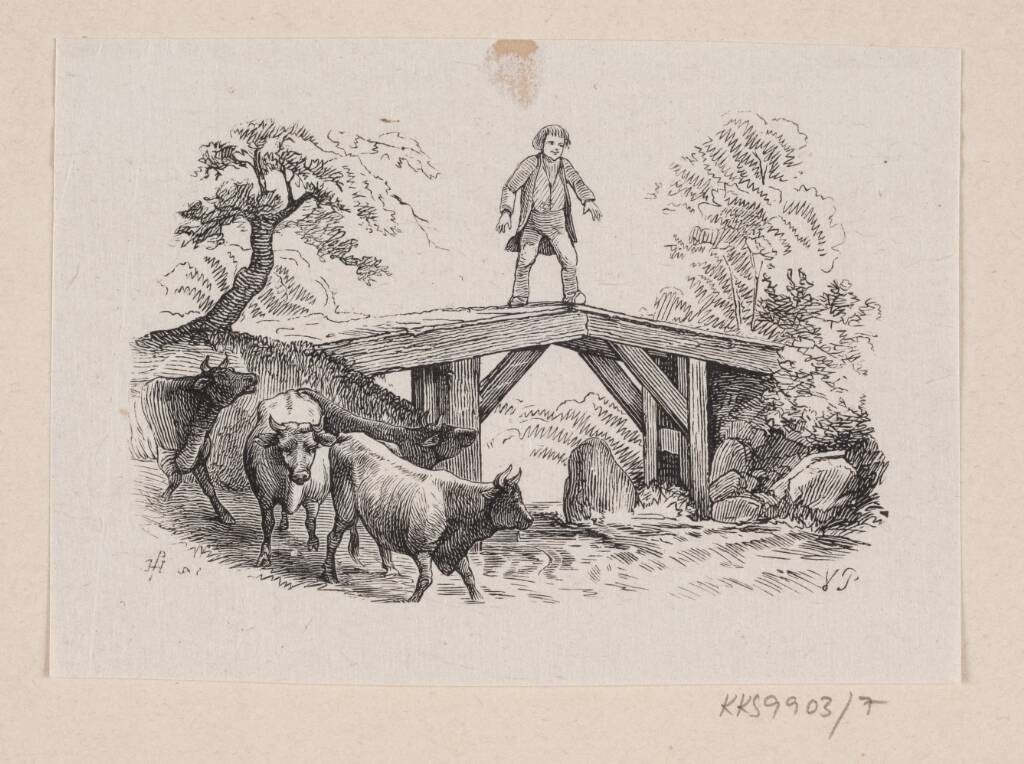
Illustration til "Store Claus og lille Claus" i H.C. Andersen, "Eventyr og Historier", Bind 1
✦ Read about this
This wood engraving by H.P. Hansen illustrates "Store Claus og lille Claus" ("Big Claus and Little Claus"), one of Hans Christian Andersen's early tales, for the first volume of an edition of his collected "Eventyr og Historier" (Fairy Tales and Stories).
Made between 1870 and 1873, the illustration was produced by xylography, or wood engraving—a relief printing technique in which the image is cut into the end grain of a hardwood block. The method allowed fine detail and was widely used for book and periodical illustration in the nineteenth century, since the blocks could be printed alongside letterpress text.
The print is held by the SMK, the National Gallery of Denmark.
Background drawn from SMK — National Gallery of Denmark
Today's poem
Lines Written In Early Spring
I heard a thousand blended notes, While in a grove I sate reclined, In that sweet mood when pleasant thoughts Bring sad thoughts to the mind. To her fair works did Nature link The human soul that through me ran; And much it grieved my heart to think What man has made of man. Through primrose tufts, in that green bower, The periwinkle trailed its wreaths; And 'tis my faith that every flower Enjoys the air it breathes. The birds around me hopped and played, Their thoughts I cannot measure:-- But the least motion which they made It seemed a thrill of pleasure. The budding twigs spread out their fan, To catch the breezy air; And I must think, do all I can, That there was pleasure there. If this belief from heaven be sent, If such be Nature's holy plan, Have I not reason to lament What man has made of man?
William Wordsworth · Public domain
✦ Read about this
William Wordsworth was an English Romantic poet who, together with Samuel Taylor Coleridge, launched the Romantic Age in English literature with their joint publication Lyrical Ballads in 1798. "Lines Written in Early Spring" appeared in that collection.
The poem is built from six quatrains of alternating rhyme, mostly in a plain, ballad-like meter that matches its unadorned observation of a natural scene. The speaker sits in a grove among primroses, periwinkle, birds, and budding twigs, attributing pleasure and enjoyment to the living things around him.
Its central movement is the shift from delight to sorrow: the beauty and apparent contentment of Nature prompt the recurring lament over "what man has made of man." The natural world is presented as governed by a benevolent order, against which human treatment of fellow humans stands as a source of grief.
Background drawn from PoetryDB & Wikipedia