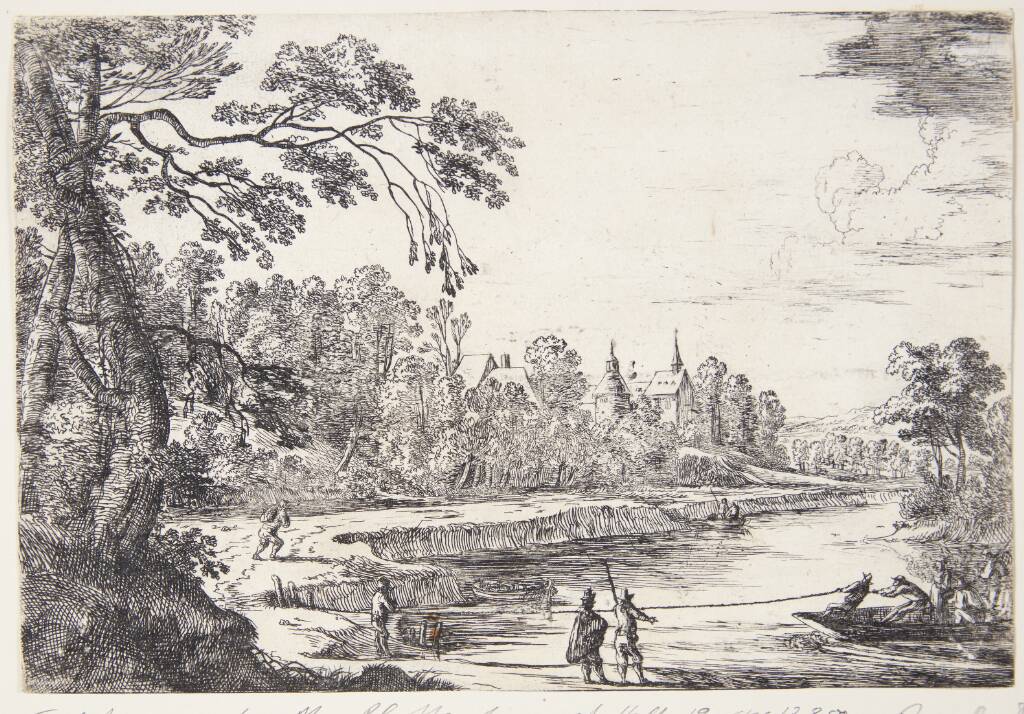
Korsvandringen
✦ Read about this
Israhel van Meckenem was among the most prolific and commercially astute engravers of the fifteenth century. Trained as a goldsmith, he worked in Germany, though his family may have had Dutch origins. He is remembered less for invention than for volume: he produced hundreds of engravings, many of them copies after other artists, and was an early figure in the business of print publishing.
*Korsvandringen* (The Bearing of the Cross) is a copperplate engraving, a technique in which lines are incised directly into a metal plate that is then inked and printed. The medium allowed images to be reproduced and distributed in quantity, making religious subjects like this one widely available.
The print dates from van Meckenem's working life, which spanned roughly 1440 to 1503. It is held in the collection of the SMK — National Gallery of Denmark.
Background drawn from SMK — National Gallery of Denmark & Wikipedia
Today's poem
Love
Why is it said thou canst not live In a youthful breast and fair, Since thou eternal life canst give, Canst bloom for ever there? Since withering pain no power possessed, Nor age, to blanch thy vermeil hue, Nor time's dread victor, death, confessed, Though bathed with his poison dew, Still thou retain'st unchanging bloom, Fixed tranquil, even in the tomb. And oh! when on the blest, reviving, The day-star dawns of love, Each energy of soul surviving More vivid, soars above, Hast thou ne'er felt a rapturous thrill, Like June's warm breath, athwart thee fly, O'er each idea then to steal, When other passions die? Felt it in some wild noonday dream, When sitting by the lonely stream, Where Silence says, 'Mine is the dell'; And not a murmur from the plain, And not an echo from the fell, Disputes her silent reign.
Percy Bysshe Shelley · Public domain
✦ Read about this
Percy Bysshe Shelley (1792–1822) was an English writer counted among the major English Romantic poets. A radical in both his poetry and his political and social views, he did not achieve fame during his lifetime, but recognition of his work grew steadily after his death, and he became an important influence on later poets including Robert Browning, Algernon Charles Swinburne, Thomas Hardy, and W. B. Yeats. Harold Bloom described him as "a superb craftsman, a lyric poet without rival."
"Love" is a lyric that treats love as an eternal, unchanging force, immune to pain, age, and death—"Fixed tranquil, even in the tomb." Cast largely as a series of questions, it asks why love should be thought incapable of enduring in a young and beautiful heart.
The poem closes on a scene of solitude, a lonely stream and silent dell where "Silence says, 'Mine is the dell,'" linking the survival of love to a still, undisturbed natural landscape.
Background drawn from PoetryDB & Wikipedia