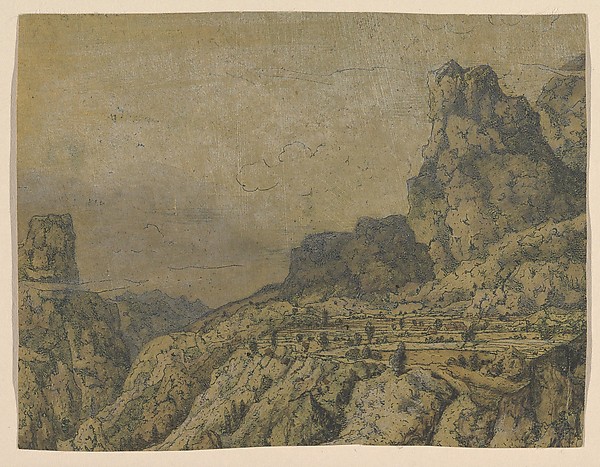
Mountain Valley with a Plateau
✦ Read about this
Hercules Segers treated printmaking as a medium for experiment rather than reproduction. In this small etching of a mountain valley, made around 1625–30, he combined line etching, drypoint, and a metal punch, printed the image in blue-green ink on a yellow-green ground, and then added color by hand with a brush. The result is closer to a unique painted object than a conventional print, and it survives here in the second of two states.
Segers (Dutch, ca. 1590–ca. 1638) worked during the Dutch Golden Age and has been called the most inventive landscapist of his time, and a still more original printmaker. His idiosyncratic techniques—colored inks, tinted grounds, and hand-coloring—produced few impressions, and his prints are correspondingly rare.
This impression entered The Met through the Harris Brisbane Dick Fund in 1923. The sheet measures roughly 10.5 by 13.8 cm.
Background drawn from The Met & Wikipedia
Today's poem
The Sea Took Pity
The sea took pity: it interposed with doom: ‘I have tall daughters dear that heed my hand: Let Winter wed one, sow them in her womb, And she shall child them on the New-world strand.’ . . . . . . . .
Gerard Manley Hopkins · Public domain
✦ Read about this
Gerard Manley Hopkins was an English poet and Jesuit priest whose reputation rests on posthumous publication; he is now counted among the leading English poets. His chief technical innovation was sprung rhythm, a metrical system that departs from conventional syllable counting, and he was known for vivid natural imagery and religious devotion.
"The Sea Took Pity" survives as a fragment, breaking off after four lines. Those lines form a quatrain in which the sea speaks, offering its "tall daughters" to be wed to Winter and to bear children on a "New-world strand." The compressed, dramatic personification of sea and season is characteristic of Hopkins's dense, forceful diction.
The piece reads as a mythologizing of natural forces, casting the elements as a family bound by marriage and birth. As an unfinished text, it offers a glimpse of Hopkins's method rather than a completed statement.
Background drawn from PoetryDB & Wikipedia