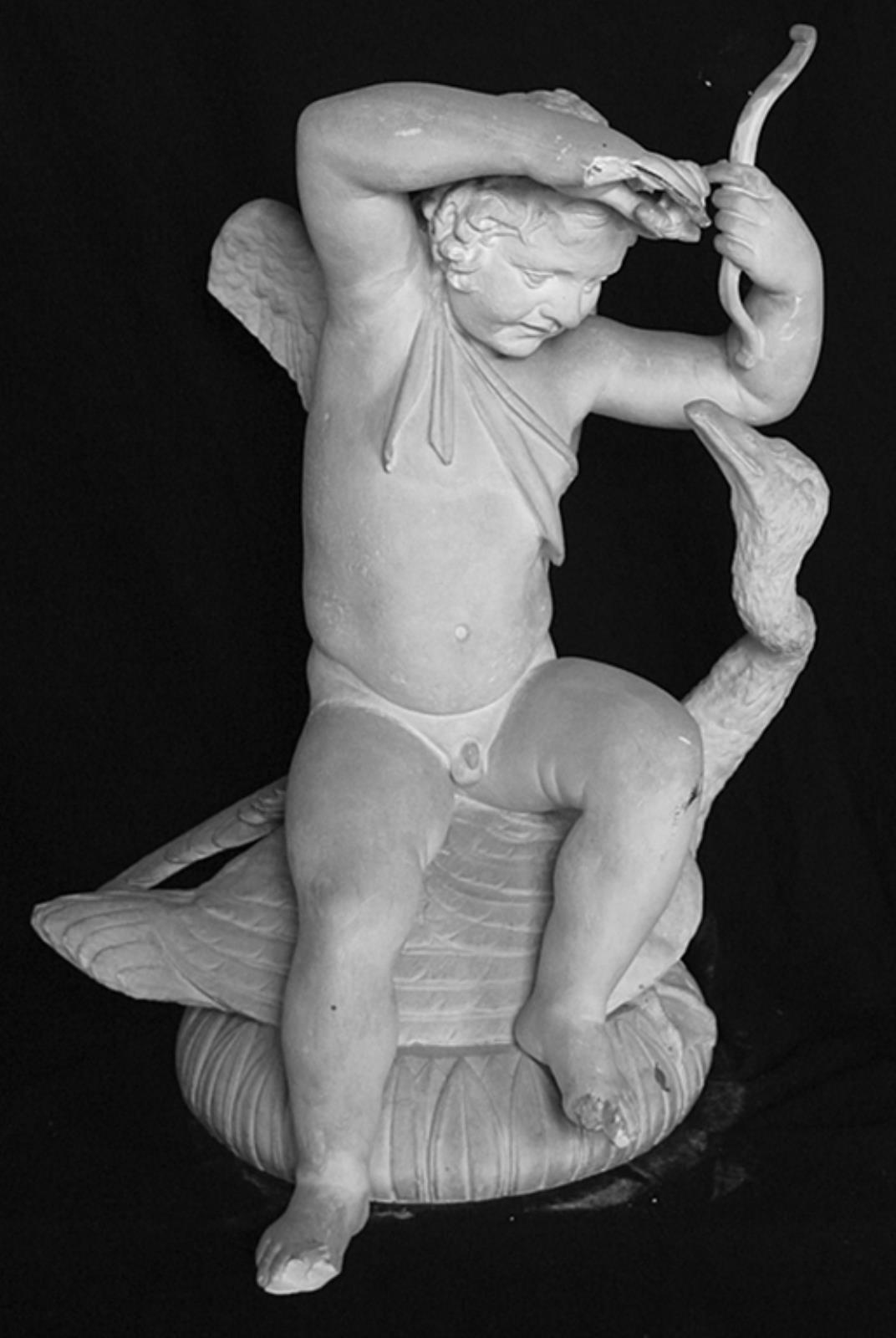
Amorin siddende på en gås eller svane
✦ Read about this
This plaster cast reproduces a sculptural group showing Amor (Cupid) seated on a goose or swan. The identity of the original sculptor is unrecorded, and the work is catalogued simply as by an unknown maker.
As a plaster cast, the piece is a copy taken from a mould rather than an original carving or bronze. Casts of this kind were long produced in large numbers for collections, academies, and art schools, where they served as reference material for study and drawing after antique and later models.
The cast is held at SMK — the National Gallery of Denmark. Neither the date of the original nor of the cast itself is documented.
Background drawn from SMK — National Gallery of Denmark
Today's poem
"Hope" is the thing with feathers
"Hope" is the thing with feathers - That perches in the soul - And sings the tune without the words - And never stops - at all - And sweetest - in the Gale - is heard - And sore must be the storm - That could abash the little Bird That kept so many warm -
Emily Dickinson · 1891 · Public domain
✦ Read about this
Emily Dickinson published almost nothing during her lifetime and was largely unknown as a poet while she lived; only after her death did her work reach readers, and it is now regarded as canonical in American literature. The Poetry Foundation credits her with creating "a distinctively elliptical language for expressing what was possible but not yet realized."
This poem is characteristic of that style. It defines hope through an extended metaphor: hope as a bird that "perches in the soul" and sings continuously, most audibly during hardship — "sweetest - in the Gale." The final stanza turns on the idea that even severe storms cannot silence the bird that has warmed so many.
The poem shows Dickinson's signature features: heavy use of dashes, irregular capitalization, compression, and a short, hymn-like stanza form. Its argument is that hope is persistent, resilient, and gives freely without asking anything in return.
Background drawn from curated & Wikipedia