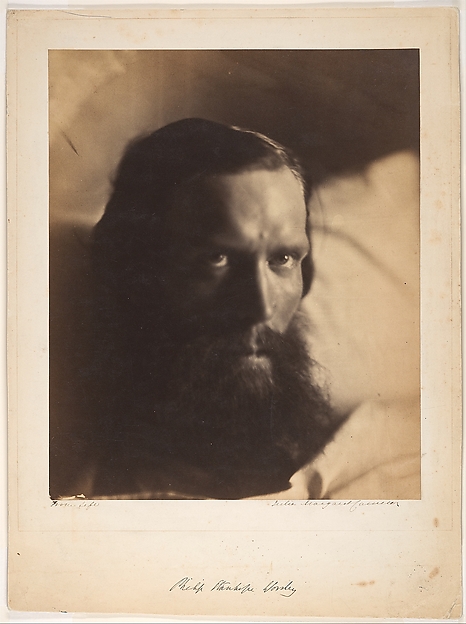
Philip Stanhope Worsley
✦ Read about this
Julia Margaret Cameron did not take up photography until 1863, when she was in her late forties and received a camera as a gift. She quickly became one of the most important portraitists of the nineteenth century, known for her deliberately soft-focus close-ups of prominent Victorians and for staged scenes drawn from mythology, Christianity, and literature. Born in Calcutta in 1815, she was British by descent and later died in Ceylon.
This portrait of Philip Stanhope Worsley dates from 1866, only a few years into her working life. It is an albumen silver print made from a glass negative, a standard photographic process of the period, with an image measuring roughly 30 by 25 centimeters.
The print entered the Metropolitan Museum of Art as part of the Gilman Collection, acquired in 2005 through the Photographs department.
Background drawn from The Met & Wikipedia
Today's poem
The Road Not Taken
Two roads diverged in a yellow wood, And sorry I could not travel both And be one traveler, long I stood And looked down one as far as I could To where it bent in the undergrowth; Then took the other, as just as fair, And having perhaps the better claim, Because it was grassy and wanted wear; Though as for that the passing there Had worn them really about the same,
Robert Frost · 1916 · Public domain
✦ Read about this
Robert Frost was an American poet known for his realistic depictions of rural life and his command of American colloquial speech. Working often from settings in early 20th-century New England, he used ordinary landscapes to examine complex social and philosophical themes.
"The Road Not Taken" is one such poem. It describes a traveler in a "yellow wood" confronting two diverging paths, choosing one because it seems "grassy and wanted wear," though the speaker immediately concedes the two were worn "really about the same." That qualification undercuts any simple reading of the poem as a celebration of individualism.
The poem is written in tightly rhymed five-line stanzas and voiced in plain, conversational language typical of Frost's style. Its subject is choice itself — how a decision is made, and how the mind retrospectively assigns meaning to a path that may have differed little from the one abandoned.
Background drawn from curated & Wikipedia