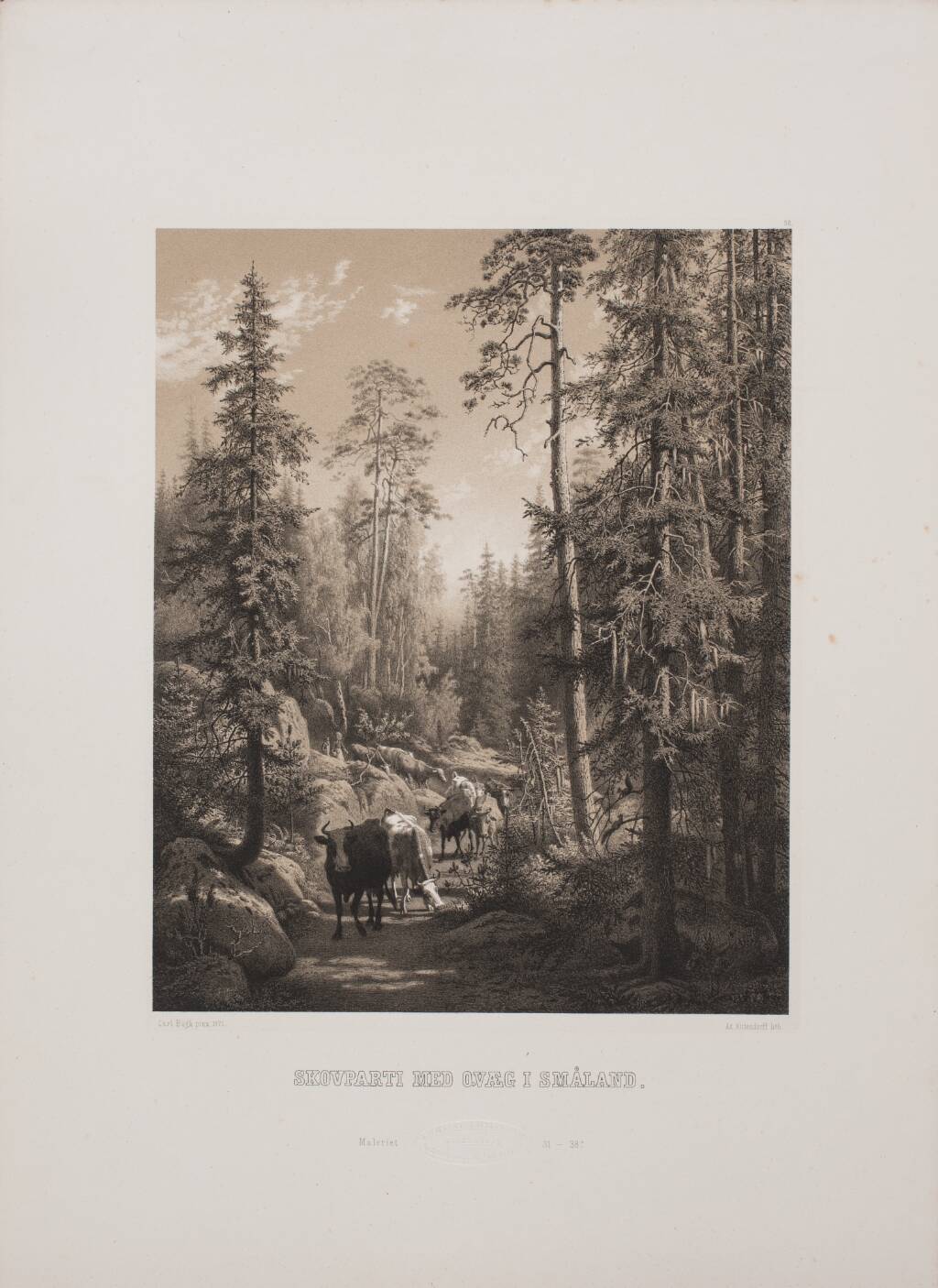
Skovparti med Kvæg i Småland
✦ Read about this
"Skovparti med Kvæg i Småland" is a color lithograph, a print produced by drawing on a stone or plate and using multiple colors—a technique that became widely used commercially in the later nineteenth century for reproducing landscape imagery.
The work was made by Adolph Kittendorff between 1880 and 1889. Its subject is a wooded scene with cattle set in Småland, a region of southern Sweden. It is held in the collection of the SMK, the National Gallery of Denmark.
Background drawn from SMK — National Gallery of Denmark
Today's poem
Happy Is England! I Could Be Content
Happy is England! I could be content To see no other verdure than its own; To feel no other breezes than are blown Through its tall woods with high romances blent; Yet do I sometimes feel a languishment For skies Italian, and an inward groan To sit upon an Alp as on a throne, And half forget what world or worldling meant. Happy is England, sweet her artless daughters; Enough their simple loveliness for me, Enough their whitest arms in silence clinging; Yet do I often warmly burn to see Beauties of deeper glance, and hear their singing, And float with them about the summer waters.
John Keats · Public domain
✦ Read about this
John Keats belonged to the second generation of English Romantic poets, alongside Byron and Shelley. His poems were in print for less than four years before he died of tuberculosis at 25, and were received indifferently in his lifetime; his reputation grew rapidly after his death, and by the end of the century he was firmly placed in the canon of English literature, strongly influencing the Pre-Raphaelite Brotherhood.
"Happy Is England! I Could Be Content" is a sonnet built on a tension between contentment with England and longing for elsewhere. The poet declares himself satisfied with English woods and "artless daughters," yet twice admits to a countervailing pull—toward "skies Italian" and the Alps in the octave, and toward women of "deeper glance" and song in the sestet. The poem's structure sets its two "Happy is England" affirmations against the recurring "Yet do I" of restless desire.
Background drawn from PoetryDB & Wikipedia