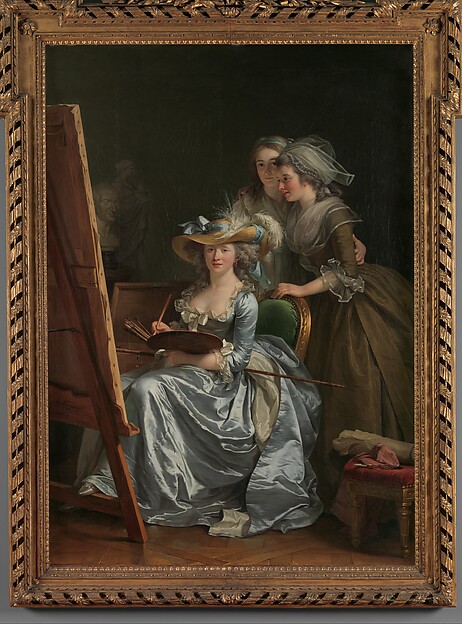
Self-Portrait with Two Pupils, Marie Gabrielle Capet (1761–1818) and Marie Marguerite Carraux de Rosemond (1765–1788)
✦ Read about this
Adélaïde Labille-Guiard (1749–1803) painted this large self-portrait in 1785, the year before she and Élisabeth Vigée Le Brun were admitted to the Royal Academy of Painting and Sculpture, one of only a handful of women ever received. She depicts herself at the easel, flanked by two of her students, Marie Gabrielle Capet and Marie Marguerite Carraux de Rosemond—a deliberate assertion of women's capacity to train as serious painters.
Labille-Guiard was an outspoken advocate for equal opportunities for women artists, and later became the first woman granted permission to establish a teaching studio in the Louvre. The nearly life-size canvas (about 211 by 151 cm) presents her not as a sitter but as a working professional and teacher.
The painting entered the Metropolitan Museum in 1953 as a gift of Julia A. Berwind.
Background drawn from The Met & Wikipedia
Today's poem
"Hope" is the thing with feathers
"Hope" is the thing with feathers - That perches in the soul - And sings the tune without the words - And never stops - at all - And sweetest - in the Gale - is heard - And sore must be the storm - That could abash the little Bird That kept so many warm -
Emily Dickinson · 1891 · Public domain
✦ Read about this
Emily Dickinson published almost none of her poetry during her lifetime and was largely unknown as a poet while she lived; her work is now regarded as canonical in American literature. The Poetry Foundation credits her with creating "a distinctively elliptical language for expressing what was possible but not yet realized," a quality visible in her compressed lines and heavy use of dashes.
"'Hope' is the thing with feathers" builds its argument from a single extended metaphor: hope as a bird that perches in the soul and sings ceaselessly. The poem uses Dickinson's characteristic short stanzas, off-rhymes, and dash-broken syntax. It sets the bird's song against images of gale and storm, insisting that hope sings most sweetly in adversity and can scarcely be silenced, and closes on the note that this "little Bird" asks nothing in return for the warmth it gives.
Background drawn from curated & Wikipedia