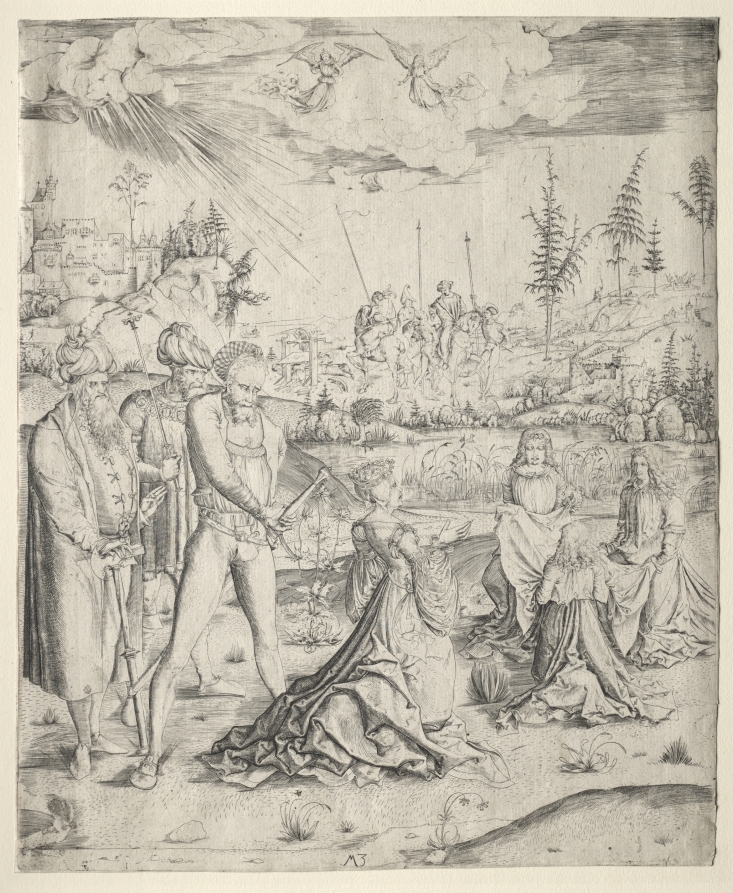
The Martyrdom of St. Catherine
✦ Read about this
Master MZ is known only by the monogram he engraved on his prints — a body of just 22 engravings, six of them dated to 1500, 1501, or 1503. He worked in Munich around the turn of the sixteenth century and appears to have had ties to the court of Albert IV, Duke of Bavaria, about 1500. His true identity remains unresolved; scholars have proposed the goldsmith Matthäus Zaisinger and the painter known as Master MS, among others, without reaching a firm conclusion.
This engraving, dated 1500–03, depicts the martyrdom of St. Catherine of Alexandria. It came to the Cleveland Museum of Art in 1925 as a gift of Ralph King.
Background drawn from Cleveland Museum of Art & Wikipedia
Today's poem
To A Friend Who Sent Me Some Roses
As late I rambled in the happy fields, What time the skylark shakes the tremulous dew From his lush clover covert;—when anew Adventurous knights take up their dinted shields; I saw the sweetest flower wild nature yields, A fresh-blown musk-rose; 'twas the first that threw Its sweets upon the summer: graceful it grew As is the wand that Queen Titania wields. And, as I feasted on its fragrancy, I thought the garden-rose it far excelled; But when, O Wells! thy roses came to me, My sense with their deliciousness was spelled: Soft voices had they, that with tender plea Whispered of peace, and truth, and friendliness unquelled.
John Keats · Public domain
✦ Read about this
John Keats was an English poet of the second generation of Romantics, alongside Byron and Shelley. His poems were in publication for less than four years before he died of tuberculosis at 25, and were received indifferently in his lifetime; his reputation grew rapidly after his death, and by the end of the century he was firmly in the canon of English literature, strongly influencing the Pre-Raphaelite Brotherhood.
The poem is a sonnet addressed to a friend, "Wells," who had sent Keats roses. Its octave describes a walk through summer fields and the discovery of a wild musk-rose, which the speaker judges superior to any cultivated garden-rose.
The turn comes with the arrival of the friend's roses, which overwhelm the speaker's senses. The closing lines give the flowers "soft voices" that whisper of peace, truth, and friendship — making the poem finally a tribute to the friend rather than to the flowers themselves.
Background drawn from PoetryDB & Wikipedia