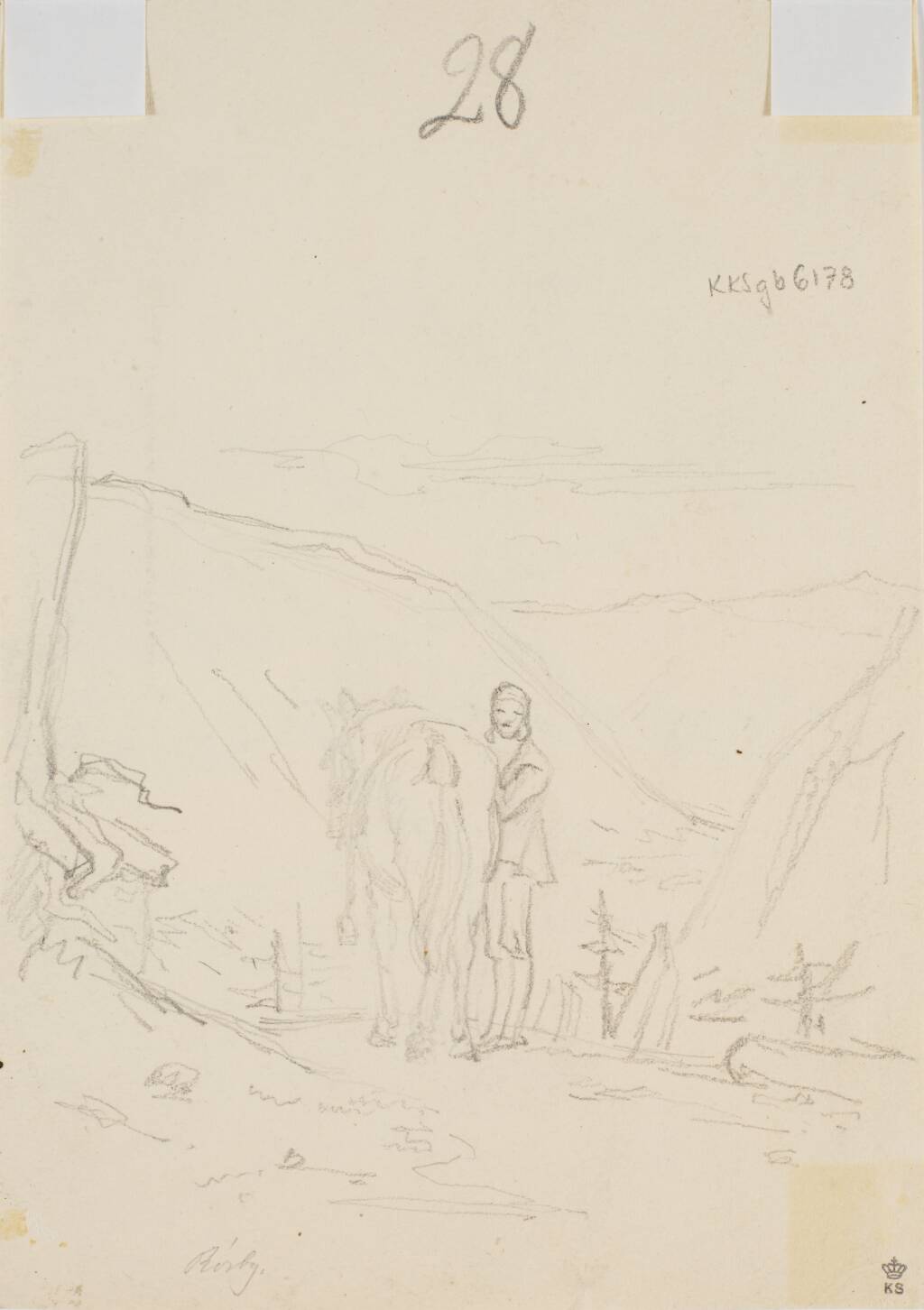
Norsk landskab med bonde stående ved hest
✦ Read about this
This pencil drawing dates from 1830, during the period known as the Golden Age of Danish painting. Its subject is a Norwegian landscape with a peasant standing beside a horse.
Martinus Rørbye (Martinus Christian Wesseltoft Rørbye) was a central figure in that movement, working across both genre scenes and landscape. The sheet, held by the National Gallery of Denmark (SMK), is a graphite study rather than a finished painting.
Norwegian motifs recur in the work of Danish artists of this era, and this drawing records a rural figure and animal observed in that setting.
Background drawn from SMK — National Gallery of Denmark & Wikipedia
Today's poem
An Enigma
"Seldom we find," says Solomon Don Dunce, "Half an idea in the profoundest sonnet. Through all the flimsy things we see at once As easily as through a Naples bonnet-- Trash of all trash!--how _can_ a lady don it? Yet heavier far than your Petrarchan stuff-- Owl-downy nonsense that the faintest puff Twirls into trunk-paper the while you con it." And, veritably, Sol is right enough. The general tuckermanities are arrant Bubbles--ephemeral and _so_ transparent-- But _this is_, now--you may depend upon it-- Stable, opaque, immortal--all by dint Of the dear names that lie concealed within't.
Edgar Allan Poe · Public domain
✦ Read about this
Edgar Allan Poe (American writer, poet, editor, and critic) is best known for his tales of mystery and the macabre and as a central figure of American Romanticism and Gothic fiction. He was among the first successful American practitioners of the short story and a pioneer of detective fiction, and is often credited with helping shape science fiction. He was the first well-known American writer to attempt to live entirely on his writing, a choice that left him in persistent financial hardship.
"An Enigma" is a sonnet that plays against the sonnet form itself: it opens with a mock-authority, "Solomon Don Dunce," dismissing sonnets as flimsy, transparent trifles, and Petrarchan verse as "owl-downy nonsense."
The poem is also a puzzle. It closes by claiming its own permanence rests on "the dear names that lie concealed within't"—a name spelled out through the letters of the lines, in the tradition of Poe's acrostic and name-poems.
Background drawn from PoetryDB & Wikipedia