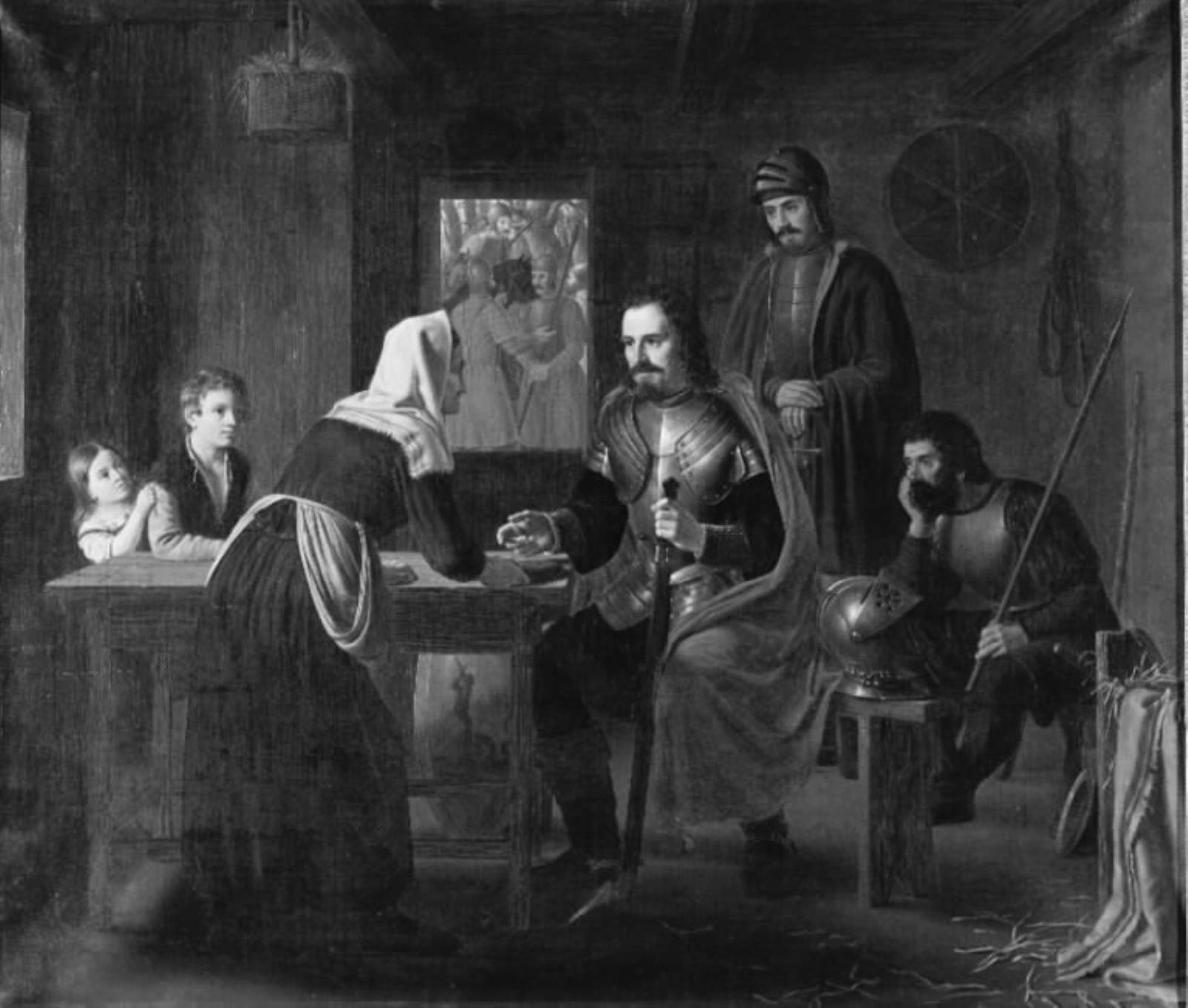
Niels Ebbesen besøger en fattig kone på vej til Randers, morgenen efter grev Gerts død
✦ Read about this
Peter Raadsig was a Danish painter who specialized in scenes from Danish and Scandinavian history, and this oil on canvas is a characteristic example of that focus. Dated between 1821 and 1836, it now belongs to the SMK — National Gallery of Denmark.
The subject draws on a well-known episode of the medieval past: Niels Ebbesen visiting a poor woman on his way to Randers, set on the morning after the death of Count Gerhard. The scene reflects the nineteenth-century Danish interest in national historical narrative, treating a figure remembered for his role in the killing of the count.
Background drawn from SMK — National Gallery of Denmark & Wikipedia
Today's poem
The Human Abstract
Pity would be no more If we did not make somebody poor, And Mercy no more could be If all were as happy as we. And mutual fear brings Peace, Till the selfish loves increase; Then Cruelty knits a snare, And spreads his baits with care. He sits down with his holy fears, And waters the ground with tears; Then Humility takes its root Underneath his foot. Soon spreads the dismal shade Of Mystery over his head, And the caterpillar and fly Feed on the Mystery. And it bears the fruit of Deceit, Ruddy and sweet to eat, And the raven his nest has made In its thickest shade. The gods of the earth and sea Sought through nature to find this tree, But their search was all in vain: There grows one in the human Brain.
William Blake · Public domain
✦ Read about this
"The Human Abstract" appears in William Blake's *Songs of Experience*, and Blake was a poet, painter and printmaker who produced his own texts as illustrated, engraved plates. Largely unrecognised in his lifetime, he lived in London his entire life except for three years in Felpham, and became a seminal figure of the Romantic Age; the 20th-century critic Northrop Frye called his longer "prophetic works" the least read body of poetry in English relative to its merits.
The poem is built in short rhymed quatrains and traces how abstract virtues depend on the ills they claim to remedy: Pity requires poverty, Mercy requires unhappiness. From this Blake builds an allegorical tree, rooted in Cruelty and Humility and bearing the fruit of Deceit, sheltering the raven under its "Mystery."
The closing turn locates this tree not in nature but in the human Brain, making the whole moral system a product of the mind rather than the world.
Background drawn from PoetryDB & Wikipedia