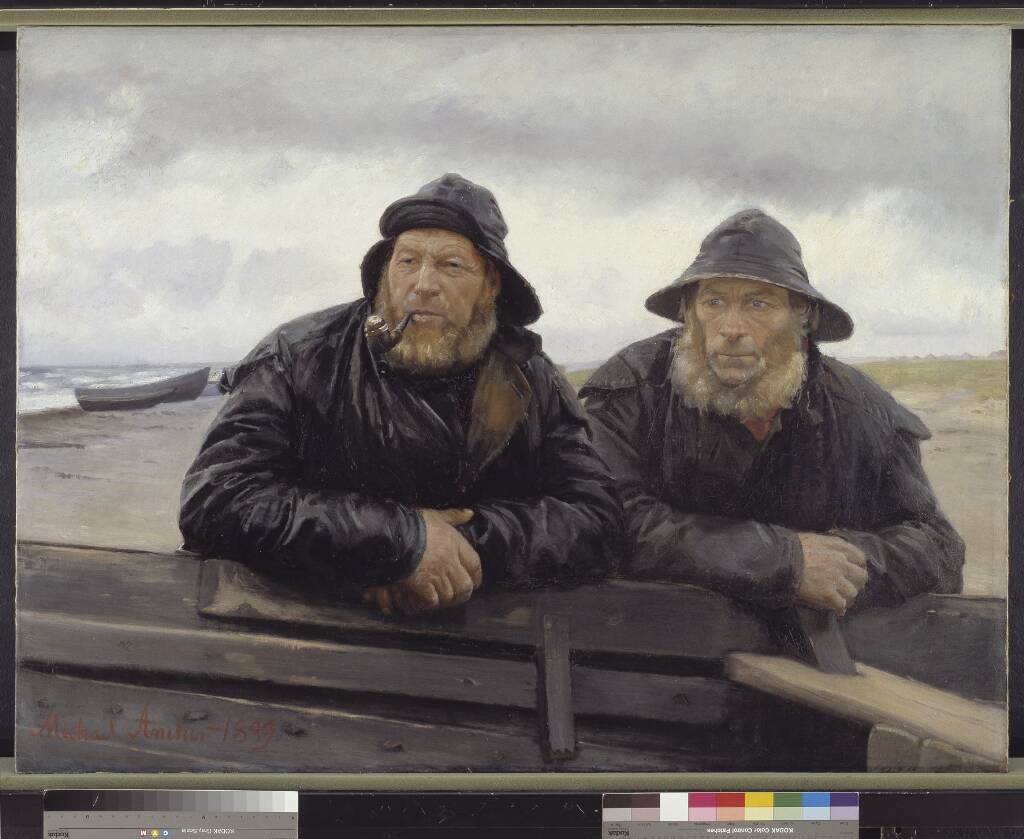
To fiskere ved en båd
✦ Read about this
Michael Ancher (1849–after) painted *To fiskere ved en båd* (Two Fishermen by a Boat) in 1889 in oil on canvas. Ancher was a Danish realist best known for scenes of the fishing community at Skagen, on the northern tip of Jutland, where the Skagerrak and North Sea meet.
The subject is characteristic of his work: fishermen and their labor along the coast. Ancher was among the artists associated with the Skagen colony, which drew painters to the region for its light and its working population.
The painting is held by SMK, the National Gallery of Denmark.
Background drawn from SMK — National Gallery of Denmark & Wikipedia
Today's poem
Divine Image
To Mercy, Pity, Peace, and Love, All pray in their distress, And to these virtues of delight Return their thankfulness. For Mercy, Pity, Peace, and Love, Is God our Father dear; And Mercy, Pity, Peace, and Love, Is man, his child and care. For Mercy has a human heart Pity, a human face; And Love, the human form divine; And Peace, the human dress. Then every man, of every clime, That prays in his distress, Prays to the human form divine: Love, Mercy, Pity, Peace. And all must love the human form, In heathen, Turk, or Jew. Where Mercy, Love, and Pity dwell, There God is dwelling too.
William Blake · Public domain
✦ Read about this
William Blake (1757–1827) was an English poet, painter and printmaker, largely unrecognised in his lifetime but later regarded as a seminal figure of the Romantic Age. He lived in London nearly his entire life, apart from three years in Felpham, producing a symbolically rich body of work in both poetry and visual art. The twentieth-century critic Northrop Frye described his self-styled "prophetic works" as among the least read poetry in the English language relative to their merits.
"The Divine Image" argues that the abstract virtues of Mercy, Pity, Peace, and Love are both God and man: divinity is located in the human form itself, consistent with Blake's conception of the imagination as "the body of God" or "human existence itself."
Written in four-line stanzas of alternating meter, the poem extends its claim across religious and cultural boundaries—naming "heathen, Turk, or Jew"—to insist that wherever these virtues dwell, God dwells too.
Background drawn from PoetryDB & Wikipedia