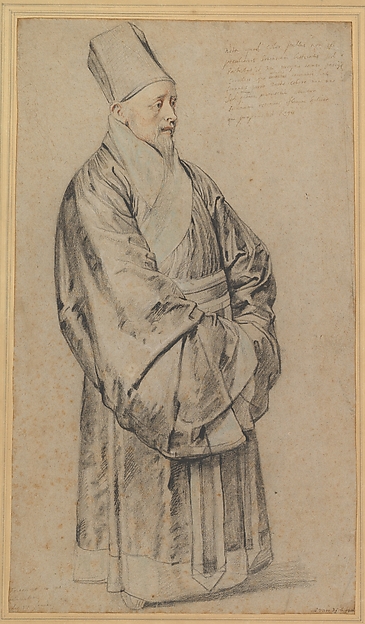
Portrait of Nicolas Trigault in Chinese Costume
✦ Read about this
The sitter, Nicolas Trigault, was a Jesuit missionary who worked in China and returned to Europe to recruit support for the mission. Rubens drew him in 1617 wearing the Chinese-style robes and cap Trigault had adopted, documenting the encounter between European and Chinese dress at a moment of expanding Jesuit activity in Asia.
Peter Paul Rubens (1577–1640) was the leading painter of the Flemish Baroque, known for large, dynamic religious and mythological compositions as well as portraits, and he worked as a diplomat. This is a working drawing rather than a finished painting, executed in black, red, and white chalk with blue pastel and pen in brown and black ink on light brown paper.
The combination of colored chalks and pastel let Rubens record the specific hues of Trigault's costume, and the sheet was likely used in preparation for further work. It was acquired by The Met in 1999.
Background drawn from The Met & Wikipedia
Today's poem
Dust of Snow
The way a crow Shook down on me The dust of snow From a hemlock tree Has given my heart A change of mood And saved some part Of a day I had rued.
Robert Frost · 1923 · Public domain
✦ Read about this
Robert Frost was an American poet known for his realistic depictions of rural life and his command of American colloquial speech. He frequently drew on settings from early 20th-century rural New England, using them to examine complex social and philosophical themes.
"Dust of Snow" is a compact example of that method: a single small incident in a wintry landscape opens onto a larger emotional shift. The poem is a single sentence spread across two quatrains of short, tightly rhymed lines. Its plainness of diction is characteristic of Frost's colloquial style.
The poem describes a crow shaking snow from a hemlock tree onto the speaker. That momentary, ordinary event changes the speaker's mood and redeems "some part / Of a day I had rued." The gloomy associations of crow and hemlock give way to an unexpected lift, turning a slight physical accident into a quiet meditation on how small things can alter feeling.
Background drawn from curated & Wikipedia