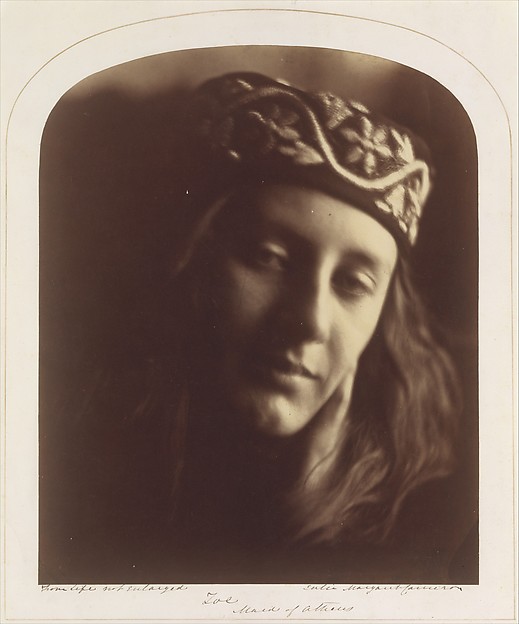
Zoe, Maid of Athens
✦ Read about this
Julia Margaret Cameron took up photography in 1863 at the age of 48, when her daughter gave her a camera, and produced her most significant work over roughly a decade before her death. Born in Calcutta in 1815, she became one of the century's leading portraitists, known for soft-focus close-ups of prominent Victorians and for staged scenes drawn from mythology, literature, and religion.
"Zoe, Maid of Athens" dates to 1866, made three years into her career. It is an albumen silver print produced from a glass negative, a standard photographic process of the period, and measures about 30 by 24.5 cm.
The image belongs to Cameron's category of illustrative or allegorical figure studies rather than her named portraits of famous sitters. It is now held by The Metropolitan Museum of Art as part of the Rubel Collection.
Background drawn from The Met & Wikipedia
Today's poem
The Road Not Taken
Two roads diverged in a yellow wood, And sorry I could not travel both And be one traveler, long I stood And looked down one as far as I could To where it bent in the undergrowth; Then took the other, as just as fair, And having perhaps the better claim, Because it was grassy and wanted wear; Though as for that the passing there Had worn them really about the same,
Robert Frost · 1916 · Public domain
✦ Read about this
Robert Frost was an American poet known for his realistic depictions of rural life and his command of American colloquial speech. He frequently drew on settings from rural New England in the early 20th century, using them to examine complex social and philosophical themes.
"The Road Not Taken" is characteristic of that method: it takes a plain scene — a walker facing two paths that diverge in a yellow wood — and turns it toward larger questions about choice. The speaker studies one road, then takes the other, calling it grassier and less worn, only to concede that the two were "worn really about the same."
The poem is written in measured stanzas with a regular rhyme scheme, and its conversational tone is typical of Frost's use of everyday speech. Its apparent simplicity has often masked the irony in the speaker's account of the choice.
Background drawn from curated & Wikipedia