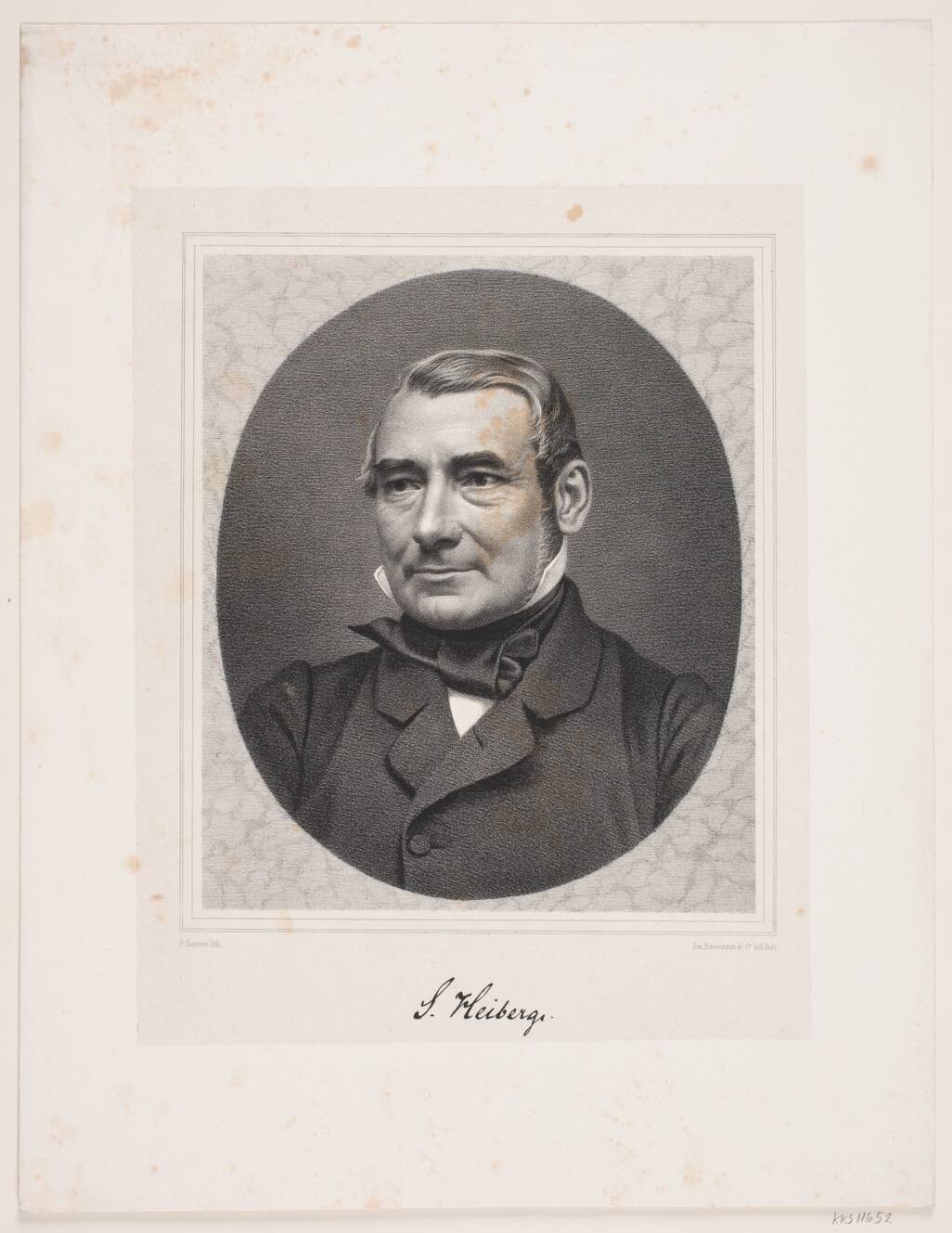
Søren Johan Heiberg
✦ Read about this
This lithograph portrait of Søren Johan Heiberg was produced in 1862 by the Danish printmaker Peter Henrik Gemzøe. It survives in the collection of the SMK — National Gallery of Denmark.
The work was made as a lithograph printed on mounted paper (påslået papir), a technique in which the printed sheet is affixed to a secondary support. Lithography, based on the mutual repulsion of grease and water on a prepared stone surface, was widely used in the nineteenth century for portraiture and reproductive prints, allowing images to be issued in multiple impressions.
Background drawn from SMK — National Gallery of Denmark
Today's poem
The Lily
The modest Rose puts forth a thorn, The humble sheep a threat'ning horn: While the Lily white shall in love delight, Nor a thorn nor a threat stain her beauty bright.
William Blake · Public domain
✦ Read about this
William Blake was an English poet, painter, and printmaker who went largely unrecognised in his lifetime but became a central figure of the Romantic Age. He spent almost his entire life in London, apart from three years in Felpham, and produced a body of work rich in symbolism, embracing the imagination as "the body of God." The 20th-century critic Northrop Frye called his "prophetic works" the least read poetry, relative to its merits, in the English language.
"The Lily" is a brief four-line poem built on contrast. Where the rose has a thorn and the sheep a horn, the lily offers neither defence nor threat, and so its beauty remains unstained. The rhyming couplets, with internal rhyme in the final lines, set the guarded modesty of the other creatures against the open love embodied by the lily, which alone is free of any protective menace.
Background drawn from PoetryDB & Wikipedia