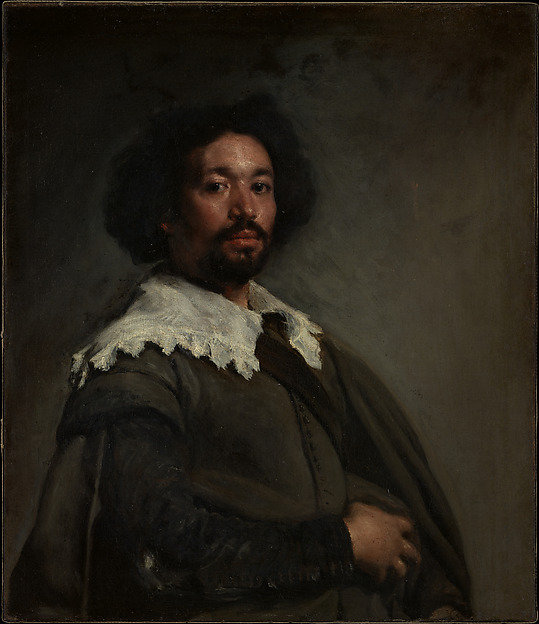
Juan de Pareja (ca. 1608–1670)
✦ Read about this
Juan de Pareja, the subject of this portrait, was of mixed African and Spanish descent and worked as an enslaved assistant in Velázquez's studio. Velázquez painted him in Rome in 1650, and Pareja was granted his freedom soon after. He went on to work as a painter in his own right.
The portrait was made while Velázquez was in Italy, and was reportedly exhibited at the Pantheon in Rome, where it drew considerable praise. Velázquez (1599–1660), court painter to Philip IV of Spain, is regarded as one of the leading figures of Spanish painting. The work is oil on canvas, roughly 81 by 70 cm.
The Metropolitan Museum of Art acquired the painting in 1971 through a combination of funds and gifts, an event that made it one of the most costly museum purchases of its time.
Background drawn from The Met
Today's poem
What Being in Rank-Old Nature
What being in rank-old nature should earlier have that breath been That hйre pйrsonal tells off these heart-song powerful peals?— A bush-browed, beetle-brуwed bнllow is it? With a soъth-wйsterly wнnd blъstering, with a tide rolls reels Of crumbling, fore-foundering, thundering all-surfy seas in; seen Ъnderneath, their glassy barrel, of a fairy green. . . . . . . . . Or a jaunting vaunting vaulting assaulting trumpet telling
Gerard Manley Hopkins · Public domain
✦ Read about this
Gerard Manley Hopkins (1844–1889) was an English poet and Jesuit priest whose reputation rests entirely on posthumous publication; he is now counted among the leading English poets. His chief technical innovation was sprung rhythm, a metre organized around stressed syllables rather than regular feet, which gives his verse its characteristic density and momentum.
This poem is a fragment, and shows Hopkins's prosody at its most concentrated. The accent marks printed over certain vowels indicate stress, guiding the reader through the sprung rhythm. Its heavily alliterative, compounded diction—"bush-browed, beetle-browed billow," "jaunting vaunting vaulting assaulting"—piles sound upon sound in the manner typical of his work.
The lines ask what natural force or "breath" lies behind a powerful sound or song, then answer with images drawn from nature: a great wave driven by a south-westerly wind, thundering surf, and the green underside of a breaking sea. The vivid natural imagery is characteristic of Hopkins's larger practice of praising God through the physical world.
Background drawn from PoetryDB & Wikipedia