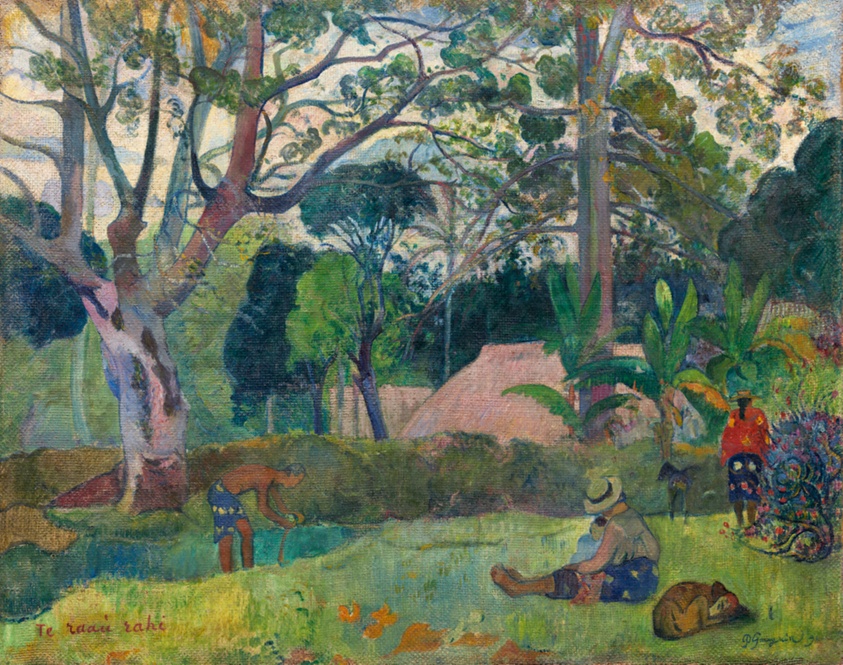
Te raau rahi (The Big Tree)
✦ Read about this
“Everything in the landscape blinded and dazzled me,” wrote Paul Gauguin of his first months in Tahiti. Here, he showcased the island’s variety of bountiful fruit trees, including a thick-trunked, violet hotu at left; spindly mango and coconut trees; and three short banana plants with lush, splayed leaves. In the foreground, a man uses a stick to crack a coconut and a family rests in the grass with a sleeping dog beside them. The painting’s coarsely woven canvas, made of a fibrous plant matter (jute), is visible through the paint layer. Cheaper and more readily available than traditional canvas, this support material lends the work a rugged, organic texture.
Background drawn from Art Institute of Chicago
Today's poem
A Thing of Beauty (Endymion)
A thing of beauty is a joy for ever: Its lovliness increases; it will never Pass into nothingness; but still will keep A bower quiet for us, and a sleep Full of sweet dreams, and health, and quiet breathing. Therefore, on every morrow, are we wreathing A flowery band to bind us to the earth, Spite of despondence, of the inhuman dearth Of noble natures, of the gloomy days, Of all the unhealthy and o'er-darkn'd ways Made for our searching: yes, in spite of all, Some shape of beauty moves away the pall From our dark spirits. Such the sun, the moon, Trees old and young, sprouting a shady boon For simple sheep; and such are daffodils With the green world they live in; and clear rills That for themselves a cooling covert make 'Gainst the hot season; the mid-forest brake, Rich with a sprinkling of fair musk-rose blooms: And such too is the grandeur of the dooms We have imagined for the mighty dead; An endless fountain of immortal drink, Pouring unto us from the heaven's brink.
John Keats · Public domain
✦ Read about this
These lines open *Endymion*, a long poem by John Keats (1795–1821), the English poet of the second generation of Romantics alongside Byron and Shelley. His work was in print for less than four years before he died of tuberculosis at 25, and it was indifferently received during his life. His reputation grew rapidly after his death, and by the end of the century he was firmly in the canon of English literature, influencing the Pre-Raphaelite Brotherhood.
The passage begins with one of Keats's most quoted lines, "A thing of beauty is a joy for ever." Written in rhyming couplets, it argues that beauty is permanent and never fades into nothingness, offering rest and consolation.
Against despondence, gloomy days, and the scarcity of noble natures, the poem catalogues sources of that beauty: the sun and moon, trees, sheep, daffodils, streams, musk-roses, and the remembered grandeur of the "mighty dead" — an "endless fountain of immortal drink."
Background drawn from PoetryDB & Wikipedia