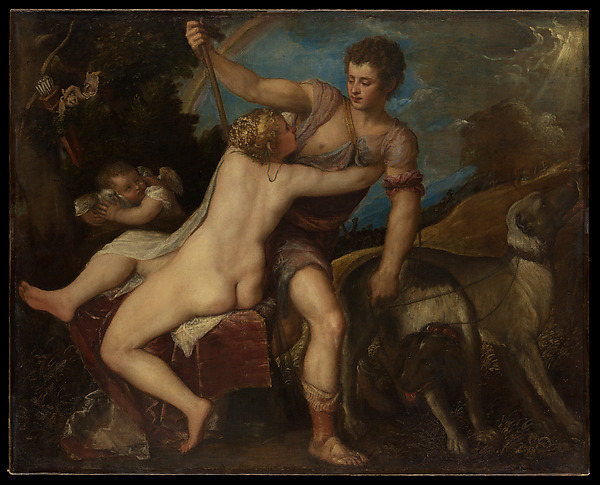
Venus and Adonis
✦ Read about this
Titian painted several versions of *Venus and Adonis* during the 1550s, and the composition became one of his most repeated and copied designs, produced with workshop assistance for patrons across Europe. This oil on canvas, measuring roughly 107 by 133 cm, entered the Metropolitan Museum of Art in 1949 as part of the Jules Bache Collection.
Titian (Tiziano Vecellio), born in Pieve di Cadore around 1485–90 and active in Venice until his death in 1576, was the leading painter of the Venetian Renaissance. His handling of oil paint—loose, layered, and emphatic in its use of color—shaped European painting for generations.
The subject derives from Ovid's *Metamorphoses*: Venus tries to hold back Adonis, who breaks from her embrace to leave for the hunt in which he will be killed. Titian treats the scene as a moment of physical tension between the two figures.
Background drawn from The Met & Wikipedia
Today's poem
I Years had been from Home
I Years had been from Home And now before the Door I dared not enter, lest a Face I never saw before Stare solid into mine And ask my Business there -- "My Business but a Life I left Was such remaining there?" I leaned upon the Awe -- I lingered with Before -- The Second like an Ocean rolled And broke against my ear -- I laughed a crumbling Laugh That I could fear a Door Who Consternation compassed And never winced before. I fitted to the Latch My Hand, with trembling care Lest back the awful Door should spring And leave me in the Floor -- Then moved my Fingers off As cautiously as Glass And held my ears, and like a Thief Fled gasping from the House --
Emily Dickinson · Public domain
✦ Read about this
Emily Dickinson (1830–1886) published almost nothing in her lifetime and was largely unknown as a poet, yet her work is now regarded as canonical. The Poetry Foundation credits her with creating "a distinctively elliptical language for expressing what was possible but not yet realized" — a quality evident in the compression and strangeness of this poem.
"I Years had been from Home" describes a return, after long absence, to a house the speaker cannot bring herself to enter. The drama is entirely internal: fear of what has changed, of a stranger's face, of finding the life once left no longer there. The speaker reaches for the latch, then withdraws and flees "like a Thief" from her own former home.
The poem uses Dickinson's characteristic short quatrains, slant rhyme, and heavy dashes, which fracture the syntax and slow the moment of hesitation. Small physical gestures — the trembling hand, the fingers moved off "as cautiously as Glass" — carry the weight of the poem's dread.
Background drawn from PoetryDB & Wikipedia