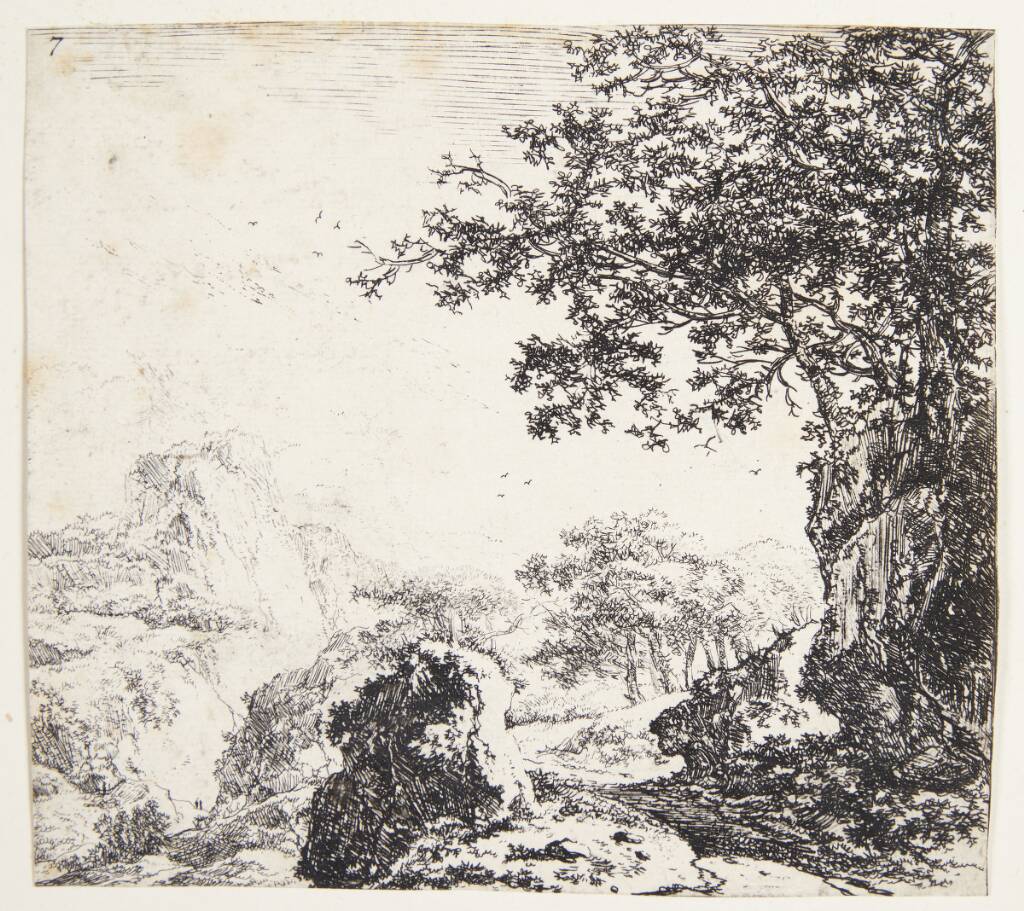
Bjergrigt landskab med en vej
✦ Read about this
Herman Naiwincx worked as both painter and printmaker during the Dutch Golden Age, and it is his prints that survive most visibly today. "Bjergrigt landskab med en vej" (Mountainous Landscape with a Road) is an etching, a technique in which the design is bitten into a metal plate with acid before printing.
The sheet dates to the period 1623–1670 and belongs to the tradition of Dutch landscape printmaking, in which imagined or composite scenery—here a mountainous terrain crossed by a road—was a common subject. It is held in the collection of the SMK, the National Gallery of Denmark.
Background drawn from SMK — National Gallery of Denmark & Wikipedia
Today's poem
Summer Sun
Great is the sun, and wide he goes Through empty heaven with repose; And in the blue and glowing days More thick than rain he showers his rays. Though closer still the blinds we pull To keep the shady parlour cool, Yet he will find a chink or two To slip his golden fingers through. The dusty attic spider-clad He, through the keyhole, maketh glad; And through the broken edge of tiles Into the laddered hay-loft smiles. Meantime his golden face around He bares to all the garden ground, And sheds a warm and glittering look Among the ivy's inmost nook. Above the hills, along the blue, Round the bright air with footing true, To please the child, to paint the rose, The gardener of the World, he goes.
Robert Louis Stevenson · Public domain
✦ Read about this
Robert Louis Stevenson (1850–1894) was a Scottish novelist, essayist, poet and travel writer, best known for the novels Treasure Island, Strange Case of Dr Jekyll and Mr Hyde, and Kidnapped. Alongside this adventure and horror fiction, he wrote for children, and "Summer Sun" comes from his 1885 collection A Child's Garden of Verses.
The poem is built from five quatrains in rhymed couplets, with a regular, sing-song meter suited to a young reader. It personifies the sun as an active, benevolent figure who "goes / Through empty heaven," slipping his "golden fingers" through drawn blinds and keyholes into the shady parlour, the dusty attic, and the hay-loft.
The sun reaches everywhere, from the ivy's "inmost nook" to the garden ground, and the closing lines name him "the gardener of the World," who exists "To please the child, to paint the rose." The subject is simple: the pervasive warmth and light of a summer's day, seen through a child's eyes.
Background drawn from PoetryDB & Wikipedia