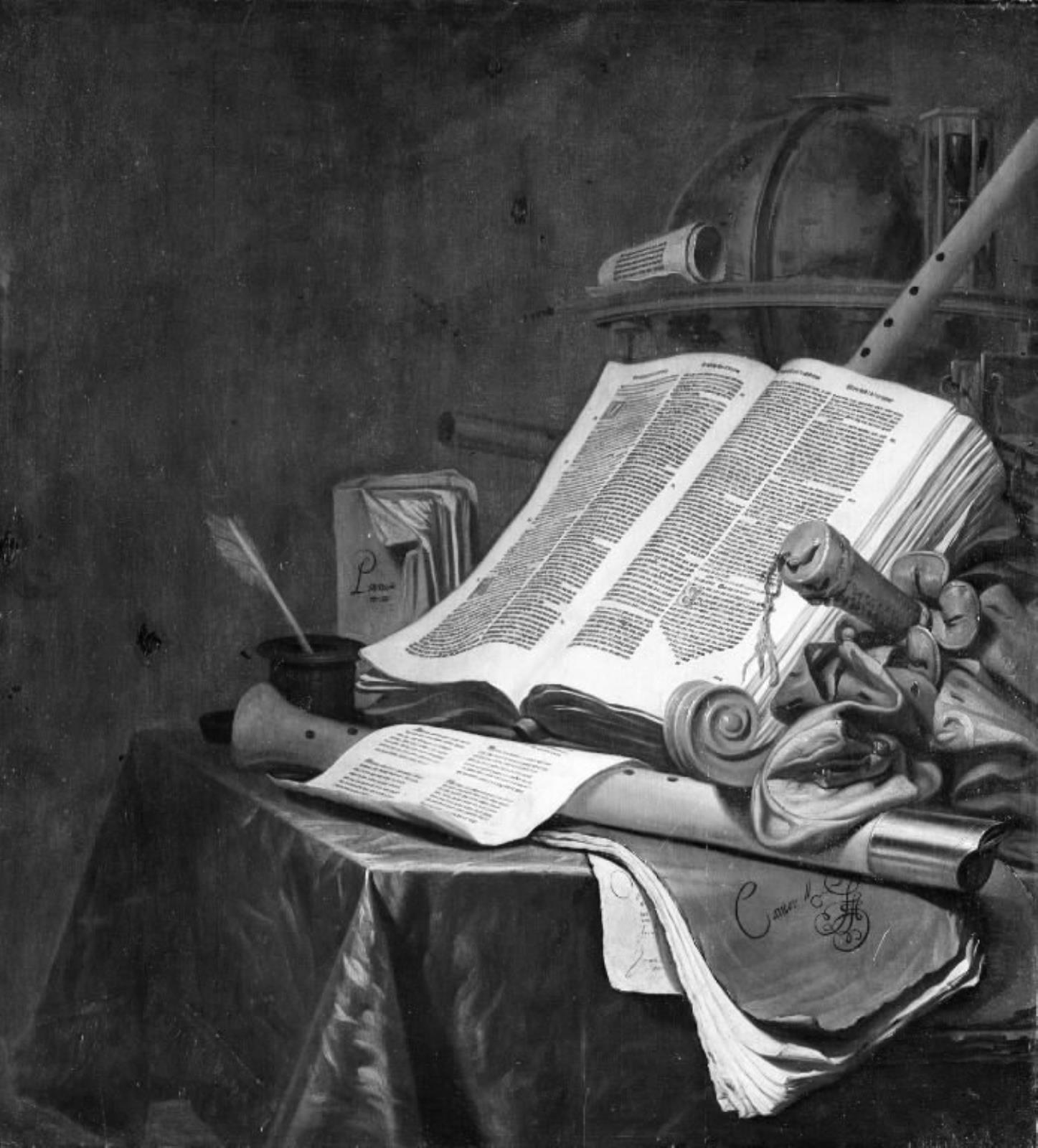
Nature morte med bøger og musikinstrumenter
✦ Read about this
Jan Vermeulen specialized in the vanitas, a category of still life designed to signal the brevity of human life and the futility of worldly pursuits. His compositions frequently center on books, as this panel does, pairing them here with musical instruments.
Also recorded as Johannes van der Molen, Vermeulen was active in Haarlem between 1638 and 1674, during the Dutch Golden Age. This still life, painted in oil on a wood panel, dates from that period.
The objects Vermeulen assembled carried established meaning: books and instruments both evoked earthly knowledge and pleasure, subjects the vanitas tradition treated as fleeting. The work is held by the SMK — National Gallery of Denmark.
Background drawn from SMK — National Gallery of Denmark & Wikipedia
Today's poem
O Sun of Real Peace.
O SUN of real peace! O hastening light! O free and extatic! O what I here, preparing, warble for! O the sun of the world will ascend, dazzling, and take his height—and you too, O my Ideal, will surely ascend! O so amazing and broad—up there resplendent, darting and burning! O vision prophetic, stagger’d with weight of light! with pouring glories! O lips of my soul, already becoming powerless! O ample and grand Presidentiads! Now the war, the war is over! New history! new heroes! I project you! Visions of poets! only you really last! sweep on! sweep on! O heights too swift and dizzy yet! O purged and luminous! you threaten me more than I can stand! (I must not venture—the ground under my feet menaces me—it will not support me: O future too immense,)—O present, I return, while yet I may, to you.
Walt Whitman · Public domain
✦ Read about this
Walt Whitman, often called the father of free verse, incorporated both transcendentalism and realism into his work and is considered one of the most influential poets in American and world literature. His 1855 collection Leaves of Grass proved controversial in its time; some described it as obscene for its overt sensuality.
"O Sun of Real Peace" is built from a chain of exclamatory apostrophes—each line an address to light, vision, or the "Ideal"—in the unrhymed, long-lined free verse Whitman helped establish. The poem registers the end of a war ("Now the war, the war is over!") and calls for "New history! new heroes!" while insisting that the "Visions of poets" are what truly endure.
The speaker greets an ascending, dazzling sun and an idealized future, but recoils from its intensity: the ground "menaces" him and the "future too immense" overwhelms, prompting a return to the present.
Background drawn from PoetryDB & Wikipedia