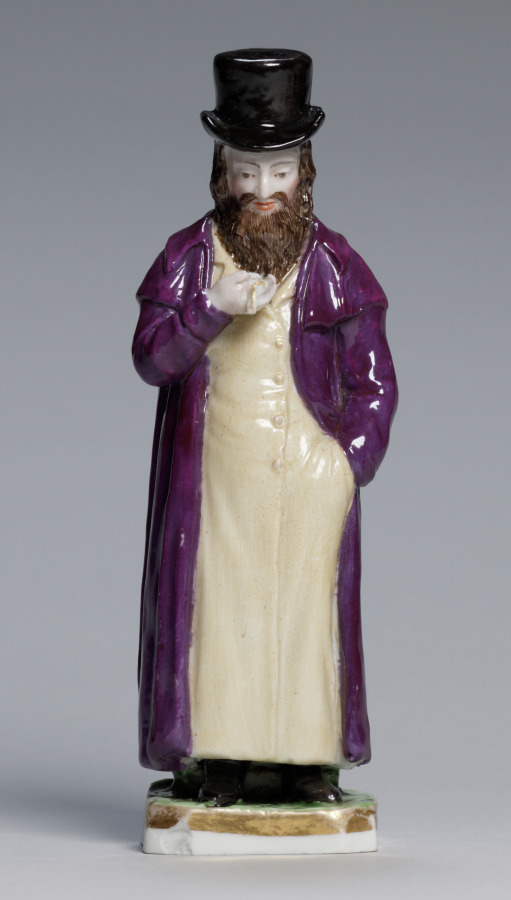
Man Holding a Watch (The Buyer)
✦ Read about this
The Gardner Factory, founded near Moscow in the 1760s by the English merchant Francis Gardner, was Russia's first successful private porcelain manufacturer and became known for figurines depicting Russian social types. This small figure, made around 1820, shows a man holding a watch and carries the alternate title "The Buyer."
Modeled in porcelain and standing about 18 centimeters tall, the piece belongs to a genre of character studies that documented the trades, classes, and everyday figures of the Russian population. Such figurines were produced in series and collected as depictions of national life.
The work is held by the Cleveland Museum of Art, acquired through the John L. Severance Fund in 1994.
Background drawn from Cleveland Museum of Art
Today's poem
Lines Written In Early Spring
I heard a thousand blended notes, While in a grove I sate reclined, In that sweet mood when pleasant thoughts Bring sad thoughts to the mind. To her fair works did Nature link The human soul that through me ran; And much it grieved my heart to think What man has made of man. Through primrose tufts, in that green bower, The periwinkle trailed its wreaths; And 'tis my faith that every flower Enjoys the air it breathes. The birds around me hopped and played, Their thoughts I cannot measure:-- But the least motion which they made It seemed a thrill of pleasure. The budding twigs spread out their fan, To catch the breezy air; And I must think, do all I can, That there was pleasure there. If this belief from heaven be sent, If such be Nature's holy plan, Have I not reason to lament What man has made of man?
William Wordsworth · Public domain
✦ Read about this
William Wordsworth was an English Romantic poet who, together with Samuel Taylor Coleridge, helped launch the Romantic Age in English literature with their joint volume *Lyrical Ballads* (1798). "Lines Written in Early Spring" was among the poems included in that collection.
The poem is built in six four-line stanzas of largely regular rhyme. Its argument moves from a scene of natural pleasure — birds, primroses, periwinkle, budding twigs — to a darker human reflection, the two held together in "that sweet mood when pleasant thoughts / Bring sad thoughts to the mind."
At its center is the contrast Wordsworth draws between the apparent joy of the natural world, which he takes on faith to be "Nature's holy plan," and human failing. The recurring lament over "what man has made of man" frames nature as morally instructive and turns a spring observation into a quiet indictment of human conduct.
Background drawn from PoetryDB & Wikipedia