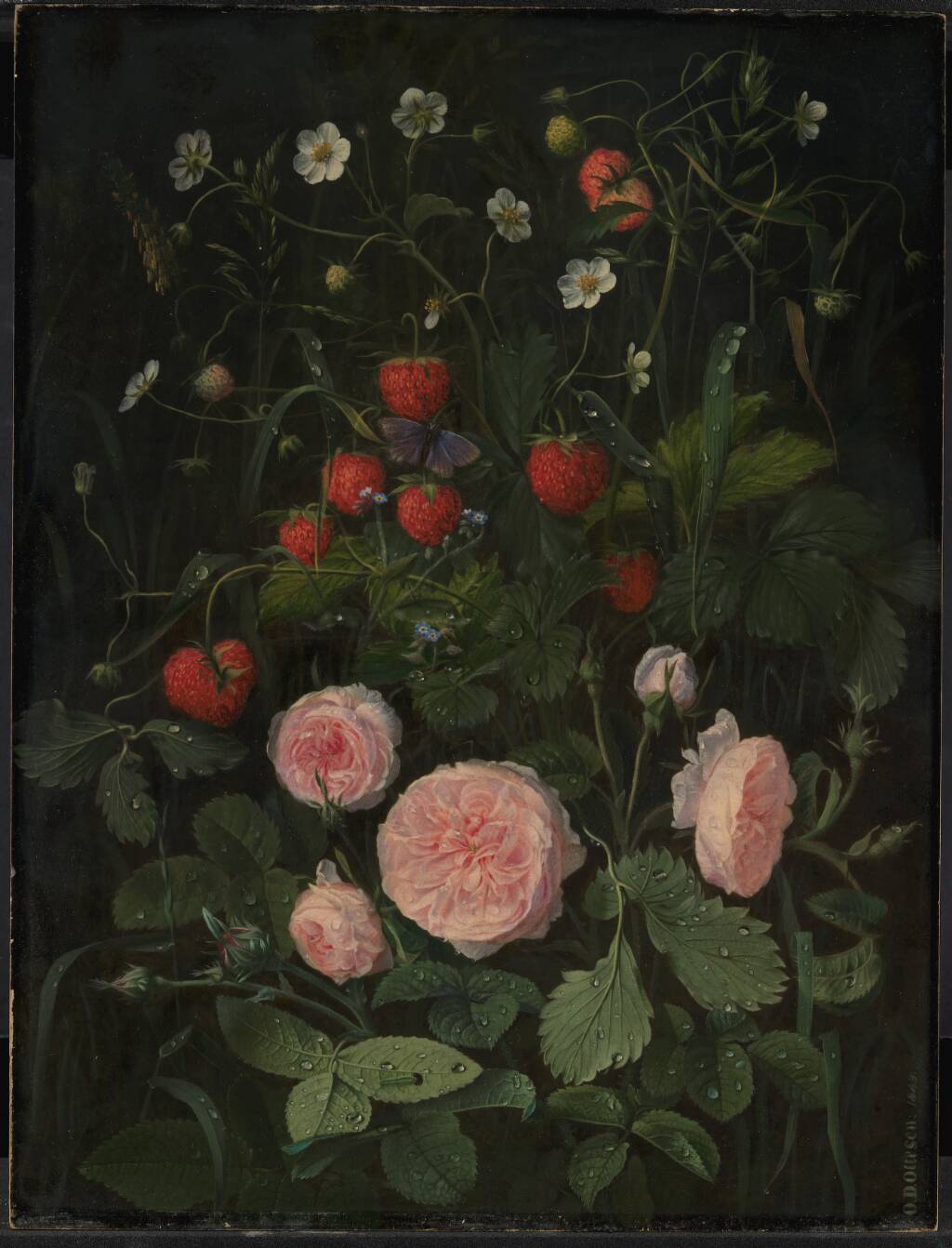
Blomsterstykke med roser og jordbær
✦ Read about this
O.D. Ottesen painted this flower piece, "Blomsterstykke med roser og jordbær" (Flower Piece with Roses and Strawberries), in oil on wood in 1843. The choice of a wooden panel rather than canvas gave the work a smooth, hard surface well suited to the fine detail of botanical painting.
Ottesen specialized in flower and plant subjects, a genre with deep roots in the Danish and Northern European still-life tradition. The pairing of roses with strawberries combines cultivated ornament and edible fruit within a single composition.
The painting is held in the collection of the National Gallery of Denmark (SMK) in Copenhagen.
Background drawn from SMK — National Gallery of Denmark
Today's poem
To Tirzah
Whate'er is born of mortal birth Must be consumed with the earth, To rise from generation free: Then what have I to do with thee? The sexes sprang from shame and pride, Blown in the morn, in evening died; But mercy changed death into sleep; The sexes rose to work and weep. Thou, mother of my mortal part, With cruelty didst mould my heart, And with false self-deceiving tears Didst bind my nostrils, eyes, and ears, Didst close my tongue in senseless clay, And me to mortal life betray. The death of Jesus set me free: Then what have I to do with thee?
William Blake · Public domain
✦ Read about this
William Blake was an English poet, painter and printmaker who was largely unrecognised in his lifetime but has since become a central figure of the Romantic Age. He worked in London for nearly all his life, apart from three years in Felpham, producing a symbolically dense body of work in which he treated the imagination as "the body of God" and "human existence itself." Northrop Frye later described Blake's "prophetic works" as, relative to their merit, the least read poetry in English.
"To Tirzah" turns on a rejection of physical, mortal existence, whose origin the speaker traces to a female figure, Tirzah, addressed as "mother of my mortal part." The poem sets natural generation and the body against spiritual liberation, twice asking "what have I to do with thee?" and concluding that "the death of Jesus set me free." It is written in short rhymed couplets across four stanzas.
Background drawn from PoetryDB & Wikipedia