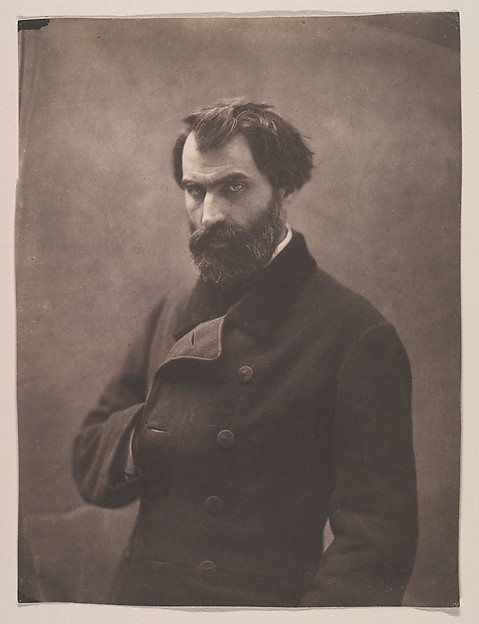
Eugène Pelletan
✦ Read about this
Made between 1855 and 1859, this salted paper print portrays the writer Eugène Pelletan. It is the work of Gaspard-Félix Tournachon (1820–1910), the Parisian photographer who worked under the single name Nadar.
Nadar came to photography from journalism and caricature, and his portrait studio drew many of the leading literary and artistic figures of mid-nineteenth-century Paris. His restrained, direct handling of the sitter—characteristic of his portraits from this decade—distinguishes his work from more ornate contemporary photography.
Nadar's career extended well beyond the studio: in 1858 he made the first aerial photographs, taken from a balloon, and he was an advocate of heavier-than-air flight. The print, measuring 23.5 by 17.6 cm, entered the Metropolitan Museum of Art in 1991.
Background drawn from The Met & Wikipedia
Today's poem
Since Thou Hast Given Me This Good Hope, O God
SINCE thou hast given me this good hope, O God, That while my footsteps tread the flowery sod And the great woods embower me, and white dawn And purple even sweetly lead me on From day to day, and night to night, O God, My life shall no wise miss the light of love; But ever climbing, climb above Man's one poor star, man's supine lands, Into the azure steadfastness of death, My life shall no wise lack the light of love, My hands not lack the loving touch of hands; But day by day, while yet I draw my breath, And day by day, unto my last of years, I shall be one that has a perfect friend. Her heart shall taste my laughter and my tears, And her kind eyes shall lead me to the end.
Robert Louis Stevenson · Public domain
✦ Read about this
Robert Louis Stevenson (1850–?) — a date the facts here do not supply — was a Scottish novelist, essayist, poet and travel writer, best known for the novels Treasure Island (1883), Strange Case of Dr Jekyll and Mr Hyde (1886) and Kidnapped (1886). Though his fame rests chiefly on his fiction, he was also a poet, notably in the collection A Child's Garden of Verses (1885).
"Since Thou Hast Given Me This Good Hope, O God" is cast as a prayer, addressed directly to God and structured around a repeated hope: that the speaker's life will "no wise miss the light of love." Its imagery moves through the natural world — flowery sod, great woods, white dawn and purple evening — and toward death, figured as "the azure steadfastness."
The poem's central subject is love, specifically the companionship of "a perfect friend" whose kind eyes will guide the speaker "to the end." It joins devotional address with a plainly stated wish for enduring human affection.
Background drawn from PoetryDB & Wikipedia