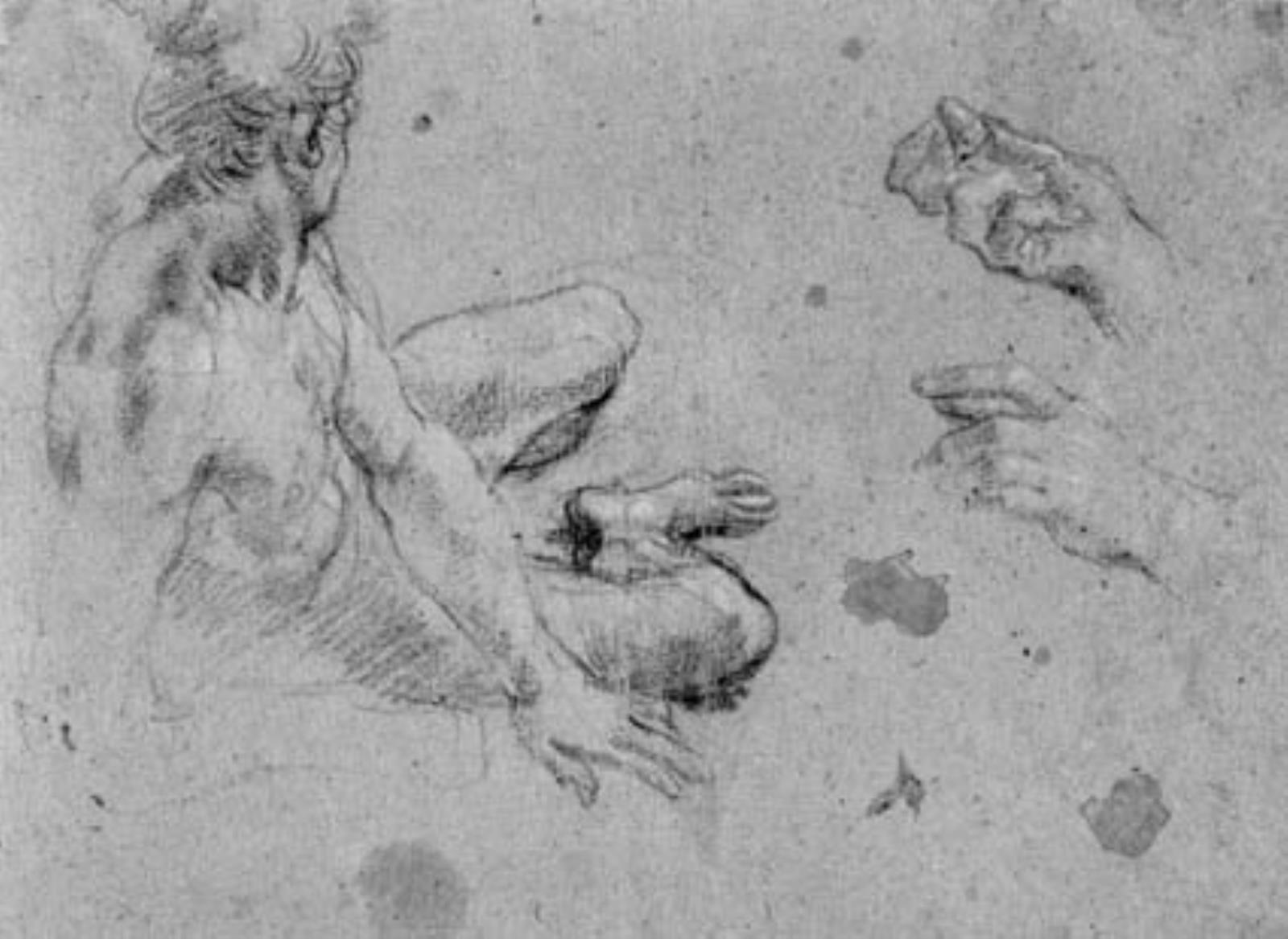
Liggende nøgen mand og studier til en venstre og en højre hånd
✦ Read about this
Sigismondo Coccapani (1583–1643) trained in Rome under Ludovico Cigoli, one of the leading Florentine painters of the period, before establishing himself back in his native Florence. He worked in the early Baroque idiom that Cigoli helped shape.
This sheet is a working study rather than a finished composition. It combines a reclining male nude with separate studies of a left and a right hand, drawn in black chalk on grey paper. The grey ground allowed the artist to model form through the chalk while reserving the paper tone for middle values.
Such figure and hand studies were standard preparatory exercises in the Florentine workshop tradition, made to resolve anatomy and gesture before transferring them to a painting. The drawing is held by the SMK — National Gallery of Denmark.
Background drawn from SMK — National Gallery of Denmark & Wikipedia
Today's poem
To R. B.
The fine delight that fathers thought; the strong Spur, live and lancing like the blowpipe flame, Breathes once and, quenchèd faster than it came, Leaves yet the mind a mother of immortal song. Nine months she then, nay years, nine years she long Within her wears, bears, cares and moulds the same: The widow of an insight lost she lives, with aim Now known and hand at work now never wrong. Sweet fire the sire of muse, my soul needs this; I want the one rapture of an inspiration. O then if in my lagging lines you miss The roll, the rise, the carol, the creation, My winter world, that scarcely breathes that bliss Now, yields you, with some sighs, our explanation.
Gerard Manley Hopkins · Public domain
✦ Read about this
"To R. B." is addressed to Robert Bridges, the friend to whom Hopkins sent his poems and who, after Hopkins's death, edited and published them. That posthumous publication secured Hopkins's reputation as one of the leading English poets, though he was little known in his lifetime.
An English poet and Jesuit priest, Hopkins was a prosodic innovator, best known for his concept of sprung rhythm and for imagery drawn from nature and directed to the praise of God. The poem is a sonnet, its argument built on an extended metaphor comparing poetic creation to conception and long gestation: inspiration comes as a brief spur or flame, and the mind then bears and moulds the resulting work over months and years.
In the sestet the poem turns personal, as Hopkins confesses a loss of that inspiration. He offers the sonnet itself as an apology and explanation to Bridges for the "lagging lines" of his "winter world," which can no longer manage the "roll, the rise, the carol, the creation."
Background drawn from PoetryDB & Wikipedia