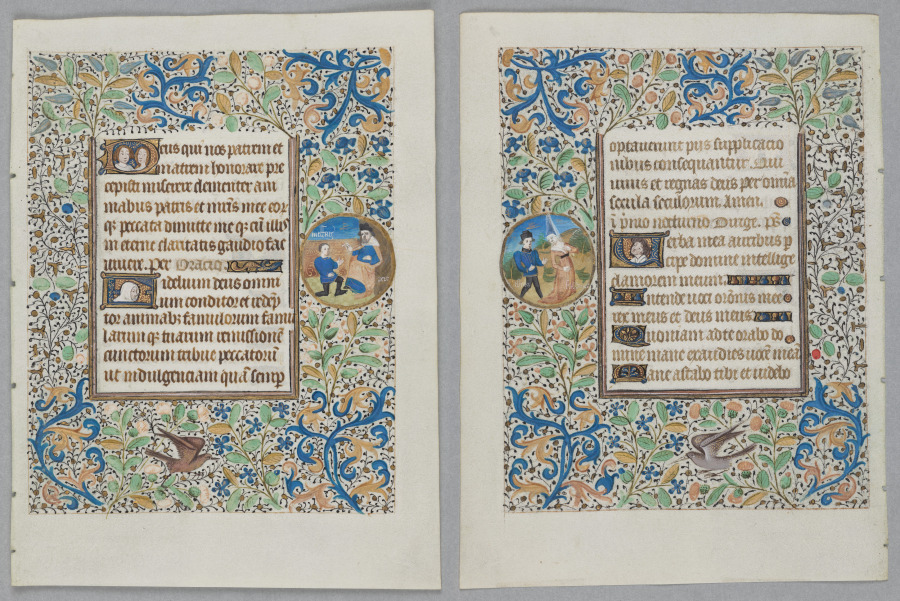
Leaf from a Book of Hours: Office of the Dead Opening Prayers (recto); Psalm 5 (verso)
✦ Read about this
The leaf shows the life of St Alexis, a monk of the 300s. His veneration became popular in France since the 1100s when the French poem la Vie de saint Alexis was written. This text is regarded as one of the earliest examples in romance language written in French and not in Latin.
Did you know? St. Alexis is depicted here as a courtly person of the 1400s to bring him close to the reader.
Background drawn from Cleveland Museum of Art
Today's poem
Defrauded I a Butterfly --
Defrauded I a Butterfly -- The lawful Heir -- for Thee --
Emily Dickinson · Public domain
✦ Read about this
Emily Dickinson published almost nothing during her lifetime and was largely unknown as a poet while she lived; the body of work now considered central to American poetry circulated only after her death. The Poetry Foundation credits her with creating "a distinctively elliptical language for expressing what was possible but not yet realized" — a description that fits the compressed, cryptic manner of this fragment.
The two surviving lines are characteristic of her most condensed writing. The syntax is inverted and elliptical: the speaker claims to have "Defrauded" a butterfly, calling it "The lawful Heir," apparently on behalf of the addressed "Thee." The lines turn on the language of inheritance and theft, framing a small act of taking as a legal wrong.
Given only these two lines, the poem's larger occasion cannot be reconstructed with confidence, but its brevity, dashes, and abrupt address are typical of Dickinson's method.
Background drawn from PoetryDB & Wikipedia