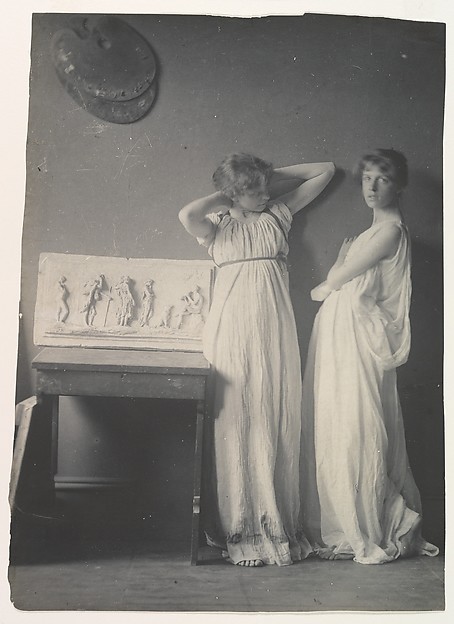
Two Pupils in Greek Dress
✦ Read about this
Thomas Eakins (1844–1916), a Philadelphia realist better known as a painter, made this platinum print in 1883, when photography was central to his teaching and studio practice. Eakins used the camera both to study the human figure and to generate material for his paintings, and he encouraged its use among his students.
The photograph shows two of his pupils posed in Greek dress, part of Eakins's engagement with classical subjects and the study of drapery and the body. The platinum process, favored for its broad tonal range and matte surface, was well suited to his interest in careful gradations of light on form.
The print measures 36.8 by 26.7 cm and entered the collection of The Metropolitan Museum of Art in 1943 through the David Hunter McAlpin Fund.
Background drawn from The Met & Wikipedia
Today's poem
The Shepherd
How sweet is the Shepherd's sweet lot! From the morn to the evening he stays; He shall follow his sheep all the day, And his tongue shall be filled with praise. For he hears the lambs' innocent call, And he hears the ewes' tender reply; He is watching while they are in peace, For they know when their Shepherd is nigh.
William Blake · Public domain
✦ Read about this
William Blake was an English poet, painter and printmaker who was largely unrecognised during his life but has since become a central figure in the poetry and visual art of the Romantic Age. He produced a symbolically rich body of work that embraced the imagination as "the body of God"; the 20th-century critic Northrop Frye described his "prophetic works" as "the least read body of poetry in the English language."
"The Shepherd" is a short lyric in two quatrains, plain in diction and pastoral in imagery. It describes the shepherd's watchful care over his flock, the lambs' call and the ewes' reply, and the peace the sheep feel knowing their keeper is near.
The pastoral scene carries a religious undertone, drawing on the traditional image of the shepherd as protector, with the sheep at rest under his watch.
Background drawn from PoetryDB & Wikipedia