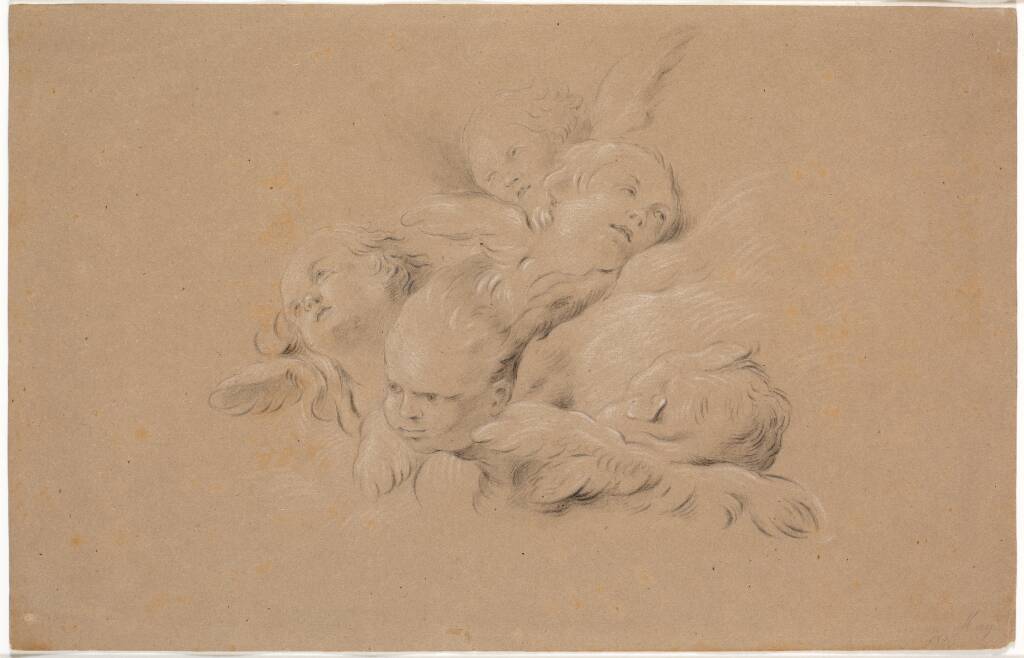
Studier af englebørns hoveder i en sky
✦ Read about this
This drawing dates from 1820, when Martinus Rørbye was still a teenager, well before he became a central figure of the Danish Golden Age of painting in the first half of the 19th century.
The sheet is a study of the heads of putti, or cherubs, set within a cloud. Rørbye worked in pencil, heightened with black and white chalk on a brownish paper — a combination that allowed both fine linear detail and a range of tonal effects, with the toned ground serving as a middle value between the light and dark chalks.
Rørbye is known for both genre scenes and landscapes. This early academic study belongs to the collection of the National Gallery of Denmark (SMK).
Background drawn from SMK — National Gallery of Denmark & Wikipedia
Today's poem
Dust of Snow
The way a crow Shook down on me The dust of snow From a hemlock tree Has given my heart A change of mood And saved some part Of a day I had rued.
Robert Frost · 1923 · Public domain
✦ Read about this
Robert Frost was an American poet known for his realistic depictions of rural life and his command of American colloquial speech. He frequently drew on settings from rural New England in the early 20th century, using them to examine complex social and philosophical themes.
"Dust of Snow" is one of Frost's shortest poems, built from a single sentence spread across two quatrains of short, mostly two- and three-beat lines. Its plain diction and rural imagery—a crow, a hemlock tree, falling snow—are characteristic of his work.
The poem records a small, ordinary incident: a crow shaking snow onto the speaker from a hemlock. That minor event shifts the speaker's mood and redeems part of a day he had regretted. From this brief, concrete moment Frost draws a larger observation about how trivial encounters with the natural world can alter a person's frame of mind.
Background drawn from curated & Wikipedia