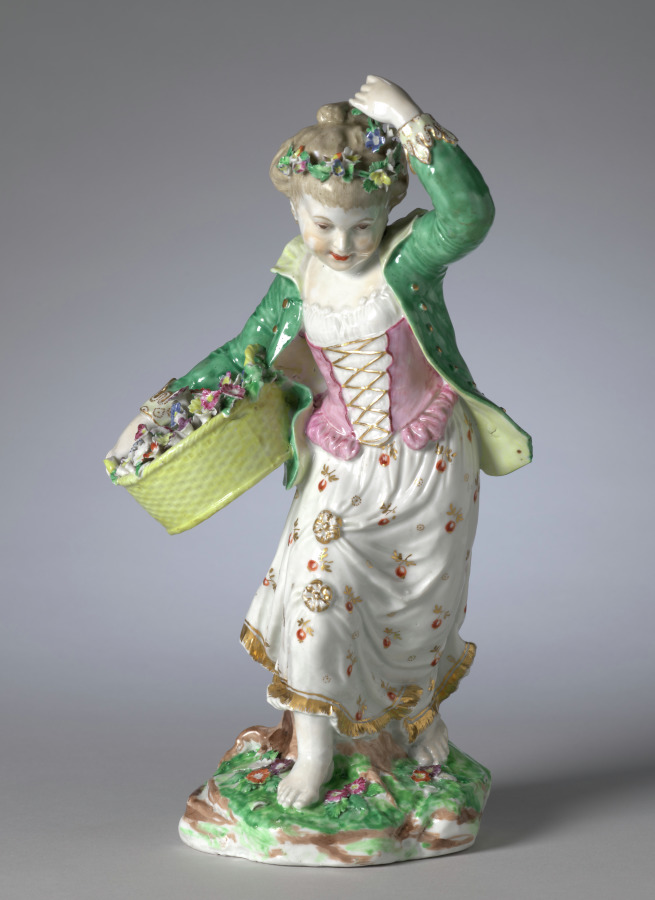
Figure of Spring from the Four Seasons
✦ Read about this
The modern notion of childhood as a time of innocence and simplicity emerged during the second half of the eighteenth century. This understanding of adolescence led to numerous depictions of children as personifications of the four seasons. Here spring is portrayed as a young girl adorning her hair with flowers. The flowers filling her basket and growing in the grass around her signal spring’s arrival.
Did you know? Allegorical figures most often decorated a table during the dessert course, providing amusing subjects for conversation.
Background drawn from Cleveland Museum of Art
Today's poem
A Thing of Beauty (Endymion)
A thing of beauty is a joy for ever: Its lovliness increases; it will never Pass into nothingness; but still will keep A bower quiet for us, and a sleep Full of sweet dreams, and health, and quiet breathing. Therefore, on every morrow, are we wreathing A flowery band to bind us to the earth, Spite of despondence, of the inhuman dearth Of noble natures, of the gloomy days, Of all the unhealthy and o'er-darkn'd ways Made for our searching: yes, in spite of all, Some shape of beauty moves away the pall From our dark spirits. Such the sun, the moon, Trees old and young, sprouting a shady boon For simple sheep; and such are daffodils With the green world they live in; and clear rills That for themselves a cooling covert make 'Gainst the hot season; the mid-forest brake, Rich with a sprinkling of fair musk-rose blooms: And such too is the grandeur of the dooms We have imagined for the mighty dead; An endless fountain of immortal drink, Pouring unto us from the heaven's brink.
John Keats · Public domain
✦ Read about this
These lines open *Endymion*, John Keats's long narrative poem based on the Greek myth of the shepherd loved by the moon goddess. Keats was an English poet of the second generation of Romantics, alongside Byron and Shelley. His poems were in publication for less than four years before he died of tuberculosis at 25, and were indifferently received in his lifetime; his reputation grew rapidly after his death, and by the end of the century he was firmly placed in the canon of English literature.
The passage, in rhyming couplets, begins with one of the most quoted lines in English poetry: "A thing of beauty is a joy for ever." It argues that beauty—found in the sun and moon, trees, daffodils, streams, musk-roses, and the remembered "mighty dead"—offsets human despondency and darkness, acting as "an endless fountain of immortal drink."
Background drawn from PoetryDB & Wikipedia