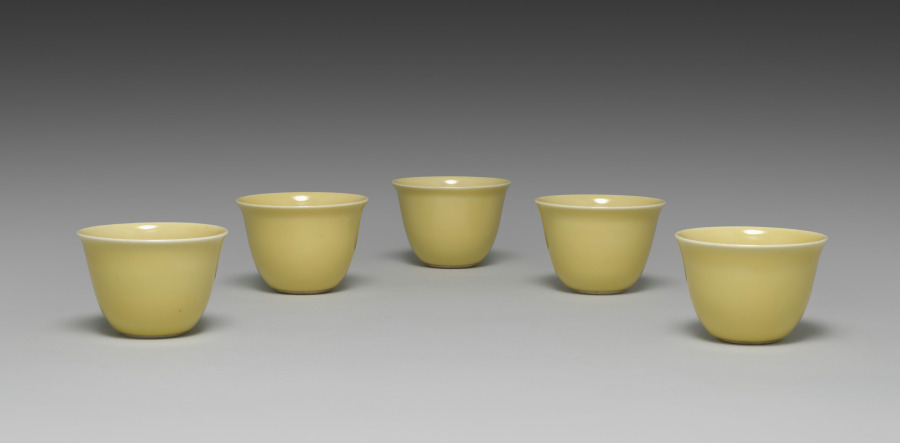
Cups
✦ Read about this
Like his father, Yohei IV also produced works with red or yellow monochrome glazes. His yellow-glazed works include this set of five drinking cups, a pair of sake pourers CMA 2022.216 , and a sweets bowl molded into the shape of a chrysanthemum CMA 2022.218 .
Did you know? Seifū Yohei IV learned the ceramics industry from his father and painting from Tanomura Shosai.
Background drawn from Cleveland Museum of Art
Today's poem
As if some little Arctic flower
As if some little Arctic flower Upon the polar hem -- Went wandering down the Latitudes Until it puzzled came To continents of summer -- To firmaments of sun -- To strange, bright crowds of flowers -- And birds, of foreign tongue! I say, As if this little flower To Eden, wandered in -- What then? Why nothing, Only, your inference therefrom!
Emily Dickinson · Public domain
✦ Read about this
Emily Dickinson published almost nothing during her lifetime and remained unknown as a poet until after her death; her work is now regarded as canonical. The Poetry Foundation credits her with creating "a distinctively elliptical language for expressing what was possible but not yet realized."
"As if some little Arctic flower" is characteristic of that ellipsis. The poem builds a single extended conditional: an Arctic flower wandering south from "the polar hem" through warmer latitudes into "continents of summer," bright crowds of flowers, and birds of foreign tongue, finally arriving in Eden itself.
The turn comes in the closing lines, which withhold any conclusion. After tracing the flower's journey and its passage into Eden, the poem asks, "What then? Why nothing, / Only, your inference therefrom!"—handing the meaning back to the reader rather than stating it. The imagined displacement of the flower stands as an unresolved figure whose significance is left open.
Background drawn from PoetryDB & Wikipedia