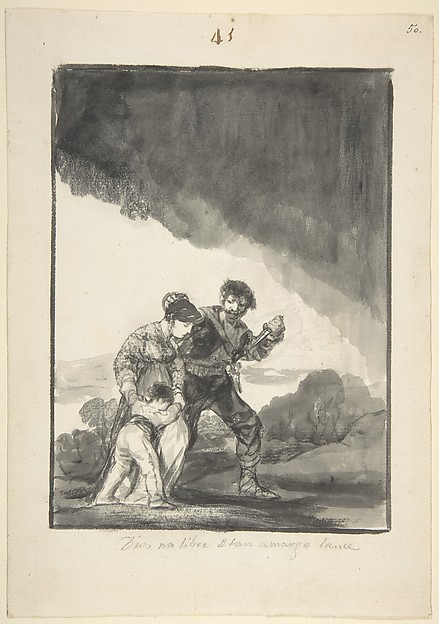
God save us from such a bitter fate; a bandit threatening a woman and a child with a knife, page 41 from the "Black Border Album" (E)
✦ Read about this
This drawing belongs to Goya's so-called "Black Border Album" (Album E), one of several private albums the artist filled with brush drawings during his later years, ca. 1816–20. The dark framing line drawn around each sheet gives the album its name. Here Goya depicts a bandit menacing a woman and child with a knife, accompanied by the inscription that translates as "God save us from such a bitter fate."
Goya (1746–1828) executed the sheet in carbon black gray ink and wash applied with the brush, working the tones with a scraper to lift highlights. The medium allowed him a painterly range of grays across the roughly 27-by-19-centimeter sheet.
Made after Goya's move away from official portraiture and toward more personal, unsettling imagery, the drawing reflects his preoccupation with violence and human cruelty. It entered the Metropolitan Museum's collection in 1935 through the Harris Brisbane Dick Fund.
Background drawn from The Met
Today's poem
Holy Thursday
Is this a holy thing to see In a rich and fruitful land,-- Babes reduced to misery, Fed with cold and usurous hand? Is that trembling cry a song? Can it be a song of joy? And so many children poor? It is a land of poverty! And their son does never shine, And their fields are bleak and bare, And their ways are filled with thorns: It is eternal winter there. For where'er the sun does shine, And where'er the rain does fall, Babes should never hunger there, Nor poverty the mind appall.
William Blake · Public domain
✦ Read about this
William Blake (1757–1827) was an English poet, painter, and printmaker, largely unrecognised in his lifetime but later regarded as a seminal figure of the Romantic Age. He produced work as both writer and visual artist, often engraving his poems alongside his own illustrations, and understood the imagination as "the body of God."
"Holy Thursday" belongs to Blake's *Songs of Experience*, the darker counterpart to a poem of the same title in *Songs of Innocence*. The poem is built as a series of angry rhetorical questions in four quatrains, contrasting the wealth of "a rich and fruitful land" with the "misery" of hungry children.
Its argument is direct: in a country where the sun shines and the rain falls, no child should go hungry, and poverty that "the mind appall" is an indictment of the society that permits it. The bleak imagery of "eternal winter" underscores Blake's protest against institutional charity and social neglect.
Background drawn from PoetryDB & Wikipedia