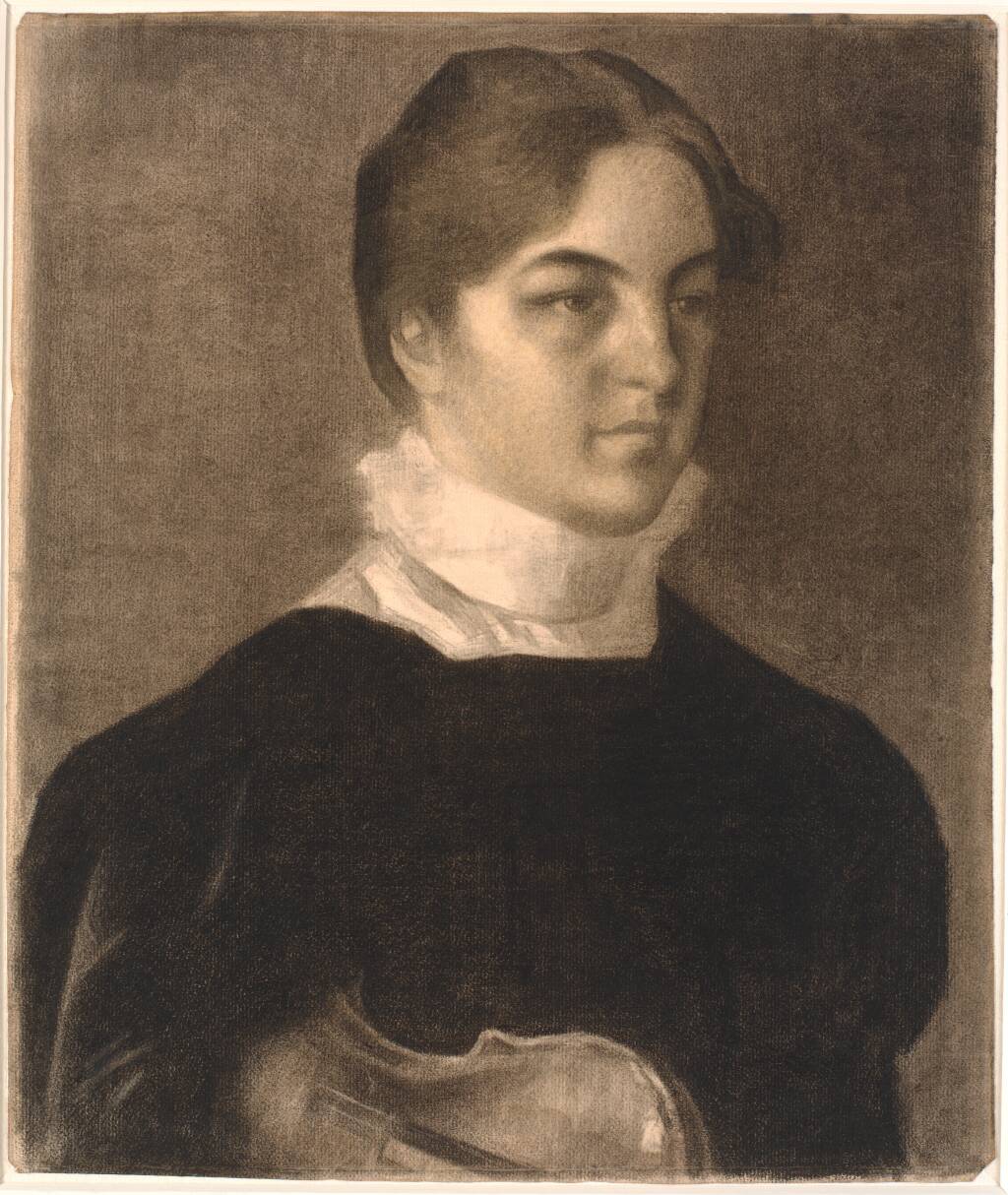
Portræt af Karen Bramsen
✦ Read about this
Unlike the muted oil interiors for which Vilhelm Hammershøi (1864–1916) is best known, this portrait of Karen Bramsen is a drawing, executed in charcoal with a yellowish wash. It dates from 1897–1898 and is held by the National Gallery of Denmark (SMK).
Hammershøi was a Danish painter celebrated for his restrained, poetic portraits and interior scenes. The subdued tonal range and quiet mood of his painted work carry over into his works on paper, where charcoal and thin washes allowed him to build form through soft gradations of light.
His reputation extended beyond Denmark. In 1905 the poet Rainer Maria Rilke described him as an artist "wide-ranging and slow," whose work offered an occasion to consider "what is important and essential in art."
Background drawn from SMK — National Gallery of Denmark & Wikipedia
Today's poem
Dust of Snow
The way a crow Shook down on me The dust of snow From a hemlock tree Has given my heart A change of mood And saved some part Of a day I had rued.
Robert Frost · 1923 · Public domain
✦ Read about this
Robert Frost was an American poet known for his realistic depictions of rural life and his command of American colloquial speech. He frequently drew on settings from rural New England in the early 20th century, using them to examine complex social and philosophical themes.
"Dust of Snow" is a compact example of that method. Its eight short lines form a single sentence, split into two quatrains: the first describes the event—a crow shaking snow down from a hemlock tree—and the second states its effect. The plain diction and tight rhyme give the small moment its weight.
The poem is about how a minor, accidental incident can shift a person's mood. The falling snow changes the speaker's heart and redeems part of a day he had otherwise regretted, drawing a large emotional consequence from an ordinary rural detail.
Background drawn from curated & Wikipedia