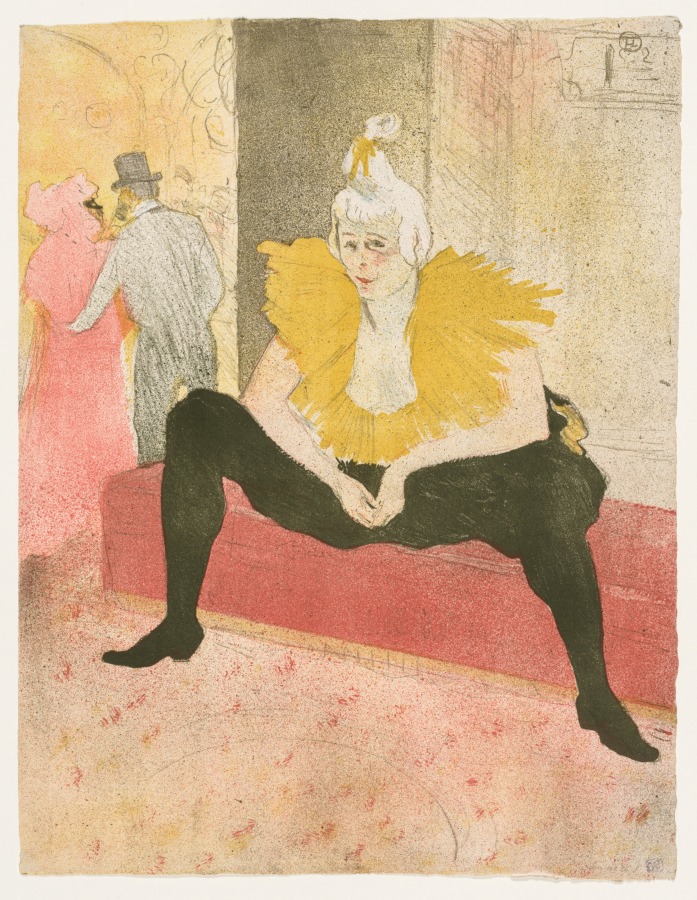
Elles: The Seated Clown, Mlle Cha-u-Ka-o
✦ Read about this
The French publisher Gustave Pellet, hoping to attract new customers, persuaded Lautrec to make a series of ten prints, plus frontispiece and cover, depicting brothels. Although it was not unusual to see prostitutes pictured in the popular press, Lautrec was the first well-known, successful artist to tackle this subject. The set was a commercial failure when it first appeared, perhaps because the scenes are not erotic. Lautrec had said that "they are women to my liking", and between 1892 and 1895 he often lived in various Parisian brothels for weeks at a time. This allowed him to witness the daily lives of the women, including the intimate acts of sleeping and bathing, and to sense their suffering. The result is that only two of the scenes show prostitutes as desirable temptresses. The remainder depict the mundane routine of the women's private world, their caring for each other, their boredom, and, living on the periphery of society, their sense of isolation. Lautrec did not take a direct moral stand. He portrayed the women sympathetically, restoring to them their humanity. One scene shows Juliette Baron, whose life of vice has led to premature aging, bringing her daughter Paulette breakfast. Other images depict the women at private moments, bathing or combing their hair in natural, relaxed poses, unaware of being observed. The beauty of the drawing and use of color makes this set one of the masterpieces of late nineteenth-century French color lithography.
Did you know? This print belongs to a portfolio published by the dealer Gustave Pellet, who created a special luxury paper that featured a watermark of his initials.
Background drawn from Cleveland Museum of Art
Today's poem
The Shepherd
How sweet is the Shepherd's sweet lot! From the morn to the evening he stays; He shall follow his sheep all the day, And his tongue shall be filled with praise. For he hears the lambs' innocent call, And he hears the ewes' tender reply; He is watching while they are in peace, For they know when their Shepherd is nigh.
William Blake · Public domain
✦ Read about this
William Blake (1757–1827) was an English poet, painter, and printmaker, largely unrecognised in his lifetime but later regarded as a seminal figure in the poetry and visual art of the Romantic Age. He lived in London almost his entire life, apart from three years at Felpham, and produced a symbolically rich body of work that embraced the imagination as "the body of God." His later "prophetic works" were called by critic Northrop Frye "the least read body of poetry in the English language" in proportion to its merits.
"The Shepherd" is a short two-stanza lyric in simple, songlike quatrains. It describes the shepherd's untroubled day watching over his flock, drawing on the pastoral imagery of sheep, lambs, and ewes. The gentle mutual awareness between shepherd and flock—the lambs' call, the ewes' reply, and the peace that comes from knowing the shepherd is near—carries a pastoral and religious resonance in keeping with the poem's calm, protective tone.
Background drawn from PoetryDB & Wikipedia