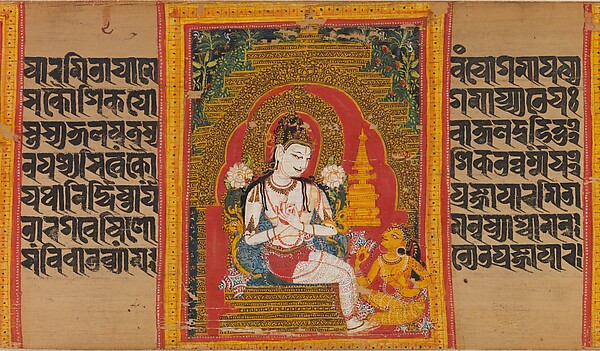
The Bodhisattva Avalokitesvara Expounding the Dharma to a Devotee: Folio from a Ashtasahasrika Prajnaparamita Sutra Manuscript
✦ Read about this
This folio comes from a manuscript of the Ashtasahasrika Prajnaparamita Sutra, the "Perfection of Wisdom in Eight Thousand Verses," a foundational Mahayana Buddhist text. The painted image is tiny—roughly 6.4 by 4.9 centimeters—set on a long, narrow palm leaf about 42 centimeters wide, the standard support for manuscripts in eastern India before paper.
It was made in early 12th-century West Bengal or Bangladesh during the Pala period, when the region's monastic centers were the leading sources of Buddhist learning and illuminated manuscripts. The painting is attributed to the Mahavihara Master and depicts the bodhisattva Avalokitesvara expounding the dharma to a devotee.
The medium is opaque watercolor applied to the palm leaf. The Metropolitan Museum acquired the folio in 2001 through the Lila Acheson Wallace Gift.
Background drawn from The Met
Today's poem
To a Locomotive in Winter.
THEE for my recitative! Thee in the driving storm, even as now—the snow—the winter-day declining; Thee in thy panoply, thy measured dual throbbing, and thy beat convulsive; Thy black cylindric body, golden brass, and silvery steel; Thy ponderous side-bars, parallel and connecting rods, gyrating, shuttling at thy sides; Thy metrical, now swelling pant and roar—now tapering in the distance; Thy great protruding head-light, fix’d in front; Thy long, pale, floating vapor-pennants, tinged with delicate purple; The dense and murky clouds out-belching from thy smoke-stack; Thy knitted frame—thy springs and valves—the tremulous twinkle of thy wheels; Thy train of cars behind, obedient, merrily-following, Through gale or calm, now swift, now slack, yet steadily careering: Type of the modern! emblem of motion and power! pulse of the continent! For once, come serve the Muse, and merge in verse, even as here I see thee, With storm, and buffeting gusts of wind, and falling snow; By day, thy warning, ringing bell to sound its notes, By night, thy silent signal lamps to swing. Fierce-throated beauty! Roll through my chant, with all thy lawless music! thy swinging lamps at night; Thy piercing, madly-whistled laughter! thy echoes, rumbling like an earthquake, rousing all! Law of thyself complete, thine own track firmly holding; (No sweetness debonair of tearful harp or glib piano thine,) Thy trills of shrieks by rocks and hills return’d, Launch’d o’er the prairies wide—across the lakes, To the free skies, unpent, and glad, and strong.
Walt Whitman · Public domain
✦ Read about this
Walt Whitman, often called the father of free verse, is considered one of the most influential poets in American and world literature. He incorporated both transcendentalism and realism into his work, which was controversial in his time—his 1855 collection Leaves of Grass was described by some as obscene for its overt sensuality.
"To a Locomotive in Winter" is a single sustained apostrophe addressed directly to a train driving through a snowstorm. Whitman catalogs its physical parts in long, accumulating lines—the black cylindric body, side-bars and connecting rods, headlight, vapor and smoke—before hailing it as the "Type of the modern" and "pulse of the continent."
The poem embraces the machine as a fit subject for poetry, its "lawless music" and shrieking whistle explicitly set against the "sweetness debonair of tearful harp or glib piano." In its free-verse form and celebration of industrial power, it treats the locomotive as an emblem of motion, strength, and self-sufficient law.
Background drawn from PoetryDB & Wikipedia