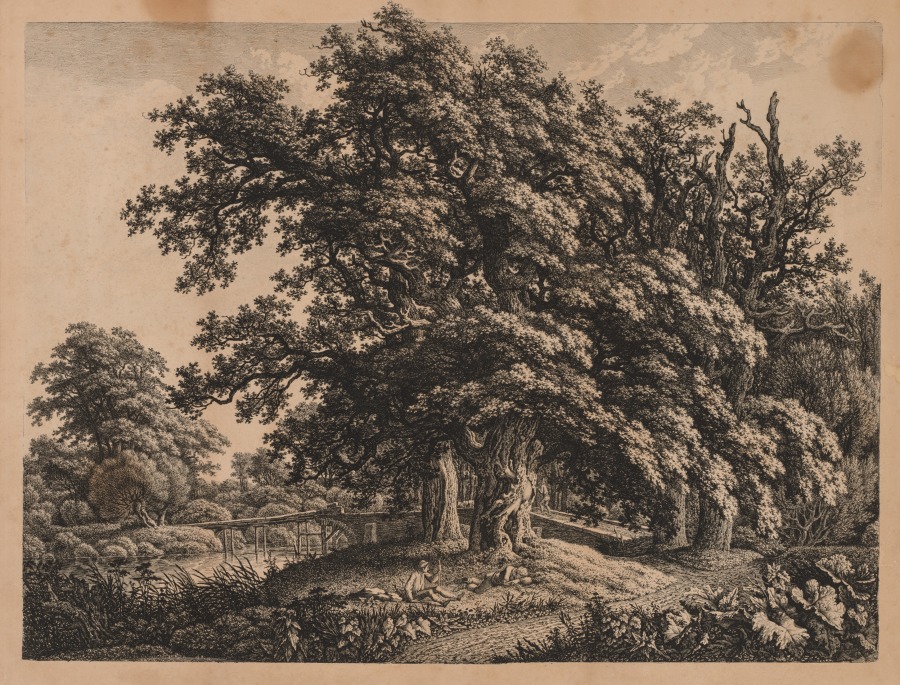
Landscape and Bridge with Three Figures
✦ Read about this
Carl Wilhelm I Kolbe (German, 1757–1835) produced this engraving, *Landscape and Bridge with Three Figures*, now in the Cleveland Museum of Art. The print combines a landscape setting with a bridge and three figures, worked in the linear technique of engraving, in which the image is incised directly into a metal plate.
The work entered the museum's collection in 1916 as a gift from Mrs. Edward W. Haines.
Background drawn from Cleveland Museum of Art
Today's poem
The Flowers
All the names I know from nurse: Gardener's garters, Shepherd's purse, Bachelor's buttons, Lady's smock, And the Lady Hollyhock. Fairy places, fairy things, Fairy woods where the wild bee wings, Tiny trees for tiny dames-- These must all be fairy names! Tiny woods below whose boughs Shady fairies weave a house; Tiny tree-tops, rose or thyme, Where the braver fairies climb! Fair are grown-up people's trees, But the fairest woods are these; Where, if I were not so tall, I should live for good and all.
Robert Louis Stevenson · Public domain
✦ Read about this
Robert Louis Stevenson (1850–1894) was a Scottish novelist, essayist, poet and travel writer best known for the novels Treasure Island, Strange Case of Dr Jekyll and Mr Hyde, and Kidnapped. Alongside that fiction he produced A Child's Garden of Verses (1885), a collection of poems written from a child's perspective, in which "The Flowers" appears.
The poem catalogues common plant names—gardener's garters, shepherd's purse, bachelor's buttons, lady's smock, hollyhock—learned, the speaker says, from a nurse. It then reimagines low-growing flowers and herbs as a miniature world of fairy woods and houses, scaled to fairies rather than "grown-up people's trees."
Written in rhymed couplets across four quatrains, it adopts the imaginative logic of a small child, who concludes that the smallest woods are the fairest and wishes to live in them, "if I were not so tall." The note of regret at being too large reflects the collection's recurring interest in the child's view of the world.
Background drawn from PoetryDB & Wikipedia