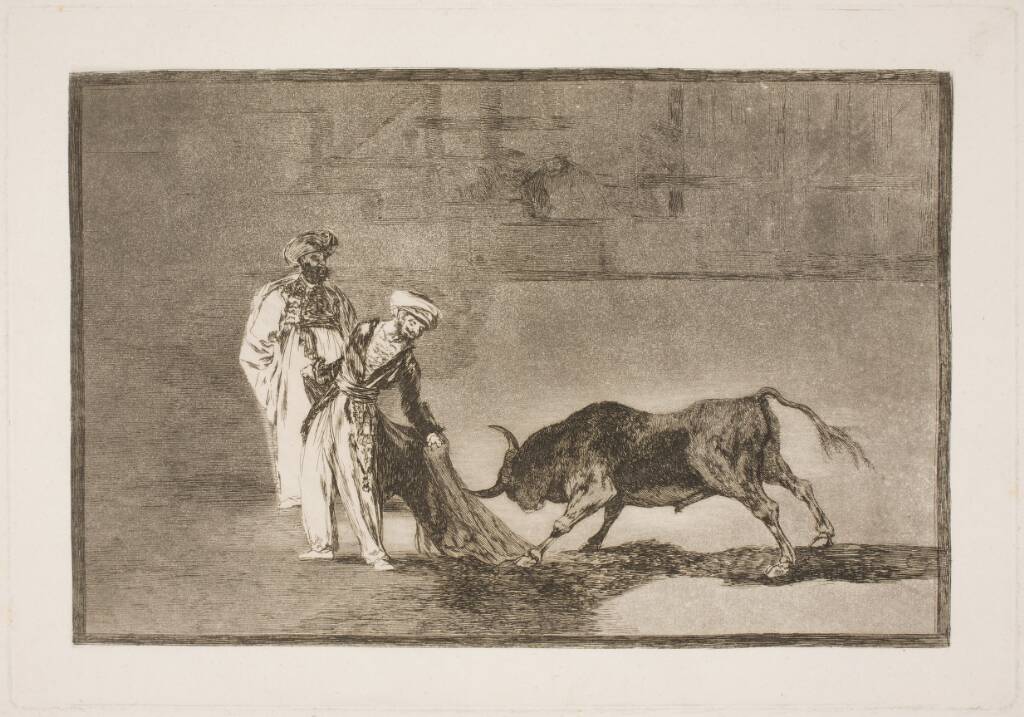
Maurerne i arenaen gør sig umage for at tiltrække sig tyren ved hjælp af deres burnus
✦ Read about this
This print belongs to Goya's *Tauromaquia*, a series on the history and practice of bullfighting produced in 1815–1816. The plate depicts Moors in the arena attempting to attract the bull with their burnous, reflecting Goya's interest in the Spanish belief that bullfighting had Moorish origins.
Francisco de Goya (1746–1828) was a Spanish painter and printmaker regarded as the most important Spanish artist of the late 18th and early 19th centuries. Often described as the last of the Old Masters and the first of the moderns, he worked across painting, drawing, and engraving, and his prints in particular shaped later 19th- and 20th-century artists.
The image was made using etching, aquatint with burnishing, and drypoint — a combination of techniques that allowed Goya tonal range and fine detail. The impression is held by the SMK, the National Gallery of Denmark.
Background drawn from SMK — National Gallery of Denmark & Wikipedia
Today's poem
A DIVINE IMAGE
Cruelty has a human heart, And Jealousy a human face; Terror the human form divine, And Secresy the human dress. The human dress is forged iron, The human form a fiery forge, The human face a furnace sealed, The human heart its hungry gorge.
William Blake · Public domain
✦ Read about this
William Blake (1757–1827) was an English poet, painter and printmaker, largely unrecognised in his lifetime but later regarded as a seminal figure in the poetry and visual art of the Romantic Age. He lived in London nearly his whole life, apart from three years in Felpham, and produced a symbolically dense body of work, including the "prophetic works" the critic Northrop Frye called among the least read poetry in English.
"A Divine Image" is a tightly compressed poem in two quatrains. It inverts the conventional idea of humanity as the image of God: instead of mercy, pity and love, the human form embodies Cruelty, Jealousy, Terror and Secrecy. The second stanza extends the image with industrial metaphors—forged iron, a fiery forge, a sealed furnace, a hungry gorge—casting the human body as a machine of suffering.
The poem belongs to Blake's preoccupation with the imagination and "human existence itself," here turned toward the darker capacities within human nature.
Background drawn from PoetryDB & Wikipedia