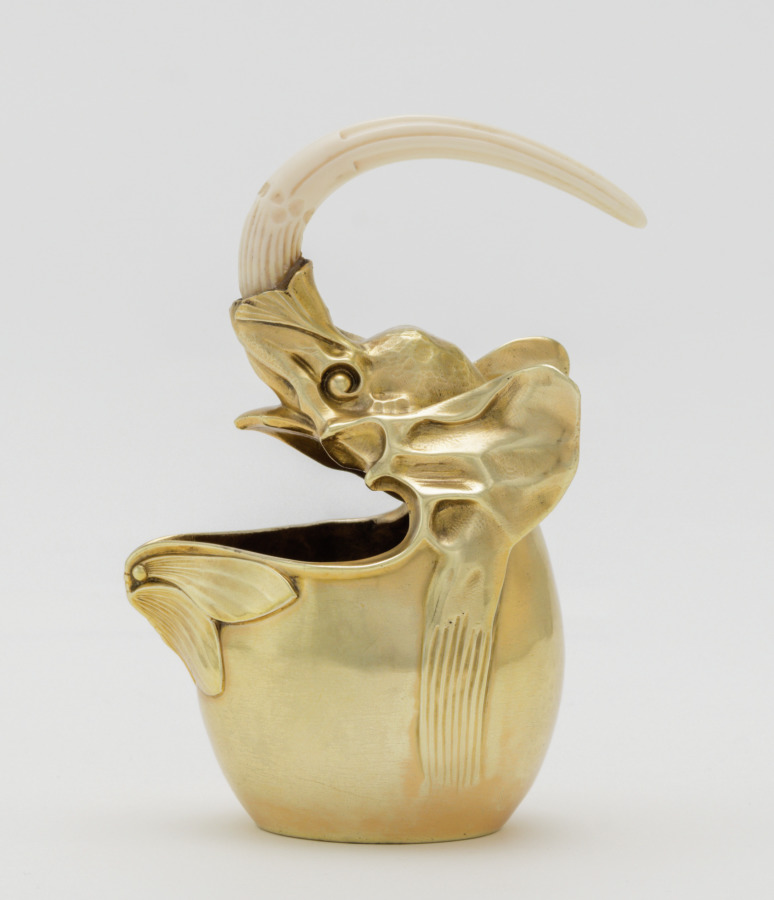
Creamer
✦ Read about this
This tea and coffee service, salver, and table, together with some now missing cups, were all designed by Carlo Bugatti as an ensemble and presented at the 1902 exposition devoted to decorative arts in Turin, Italy. The set was probably acquired from Bugatti's 1907 exhibition at the Galerie Hébrard in Paris by a wealthy South African widow, Anna Blake, who was living there at the time. Some of the animal and insect motifs suggest mythical beasts or the fossils of prehistoric animals. When Mrs. Blake returned to Cape Town, she took these and other pieces designed by Bugatti with her, and they remained in South Africa throughout her lifetime.
Did you know? This creamer is part of a tea and coffee service designed by Carlo Bugatti.
Background drawn from Cleveland Museum of Art
Today's poem
Death, To The Dead For Evermore
DEATH, to the dead for evermore A King, a God, the last, the best of friends - Whene'er this mortal journey ends Death, like a host, comes smiling to the door; Smiling, he greets us, on that tranquil shore Where neither piping bird nor peeping dawn Disturbs the eternal sleep, But in the stillness far withdrawn Our dreamless rest for evermore we keep. For as from open windows forth we peep Upon the night-time star beset And with dews for ever wet; So from this garish life the spirit peers; And lo! as a sleeping city death outspread, Where breathe the sleepers evenly; and lo! After the loud wars, triumphs, trumpets, tears And clamour of man's passion, Death appears, And we must rise and go. Soon are eyes tired with sunshine; soon the ears Weary of utterance, seeing all is said; Soon, racked by hopes and fears, The all-pondering, all-contriving head, Weary with all things, wearies of the years; And our sad spirits turn toward the dead; And the tired child, the body, longs for bed.
Robert Louis Stevenson · Public domain
✦ Read about this
Robert Louis Stevenson (1850–1894), the Scottish writer best known for the novels *Treasure Island*, *Strange Case of Dr Jekyll and Mr Hyde*, and *Kidnapped*, was also a poet and essayist. Though his most famous verse collection, *A Child's Garden of Verses* (1885), addresses childhood, his poetry ranged well beyond it.
"Death, To The Dead For Evermore" treats death not as a terror but as a welcome host and friend, "the last, the best of friends," who greets the living on a "tranquil shore" of dreamless rest. The poem moves through a series of comparisons—death as a sleeping city, the body as a tired child longing for bed—to frame the end of life as relief from the weariness of consciousness.
Its imagery turns repeatedly on exhaustion: eyes tired of sunshine, ears weary of speech, a head "racked by hopes and fears." The progression is unhurried, building toward the inevitable summons, "we must rise and go."
Background drawn from PoetryDB & Wikipedia