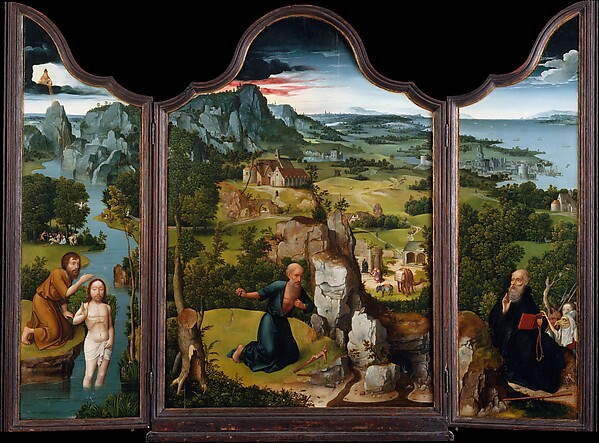
The Penitence of Saint Jerome
✦ Read about this
Joachim Patinir was the first Netherlandish painter to regard himself primarily as a landscape painter, and he effectively invented the "world landscape"—the panoramic, high-horizon vista that became a distinct genre in Northern Renaissance art. Born in Wallonia, he worked in Antwerp, then the center of the Low Countries' art market, where he was active by 1515 and died in 1524.
This triptych, painted in oil on wood around 1515, depicts the penitence of Saint Jerome across its central panel and two wings. The central panel, with its engaged frame, stands about 117.5 cm tall and is topped by a shaped arch; each wing measures roughly 120.7 by 35.6 cm.
Patinir's work marks an important stage in the development of perspective in landscape painting. The triptych entered the Metropolitan Museum of Art in 1936 through the Fletcher Fund.
Background drawn from The Met & Wikipedia
Today's poem
The Starlight Night
Look at the stars! look, look up at the skies! O look at all the fire-folk sitting in the air! The bright boroughs, the circle-citadels there! Down in dim woods the diamond delves! the elves'-eyes! The grey lawns cold where gold, where quickgold lies! Wind-beat whitebeam! airy abeles set on a flare! Flake-doves sent floating forth at a farmyard scare!— Ah well! it is all a purchase, all is a prize. Buy then! bid then!—What?—Prayer, patience, aims, vows. Look, look: a May-mess, like on orchard boughs! Look! March-bloom, like on mealed-with-yellow sallows! These are indeed the barn; withindoors house The shocks. This piece-bright paling shuts the spouse Christ home, Christ and his mother and all his hallows.
Gerard Manley Hopkins · Public domain
✦ Read about this
Gerard Manley Hopkins was an English poet and Jesuit priest whose reputation rests almost entirely on work published after his death, which placed him among the leading English poets. He is best known as a metrical innovator, particularly for his concept of sprung rhythm, and for praising God through vivid imagery drawn from the natural world.
"The Starlight Night" is a sonnet that displays both these tendencies. The poem urges the reader to look up at a night sky, which Hopkins renders through a dense accumulation of coinages and compounds — "fire-folk," "bright boroughs," "circle-citadels," "quickgold" — and through heavily stressed, exclamatory lines characteristic of his prosody.
The poem moves from observation to devotion. The stars are figured as a "purchase" and a "prize," to be bought with "Prayer, patience, aims, vows." In its closing lines the visible sky becomes a "barn" and "paling" enclosing Christ, his mother, and the saints, turning the act of looking at nature into an apprehension of the divine.
Background drawn from PoetryDB & Wikipedia