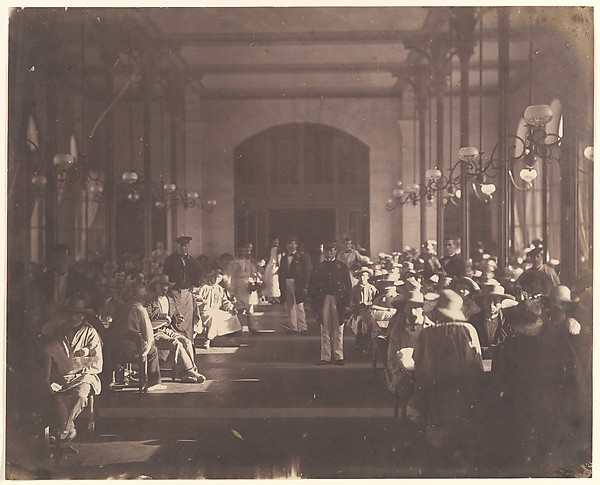
The Refectory of the Imperial Asylum at Vincennes
✦ Read about this
Charles Nègre (1820–1880) trained as a painter under Paul Delaroche, Ingres, and Drolling before turning to the still-young medium of photography, working from a studio on the Île Saint-Louis in Paris. This print belongs to a commission documenting the Imperial Asylum at Vincennes, a state institution for convalescent workers established under the Second Empire.
Made in 1858–59, the photograph records the asylum's refectory, the large communal dining hall. It is a salted paper print produced from a glass negative, a process that yielded the soft, matte tonality characteristic of early French photography.
The print entered the Metropolitan Museum's collection in 1998 as a gift of Hans P. Kraus Jr. and Mariana Cook, given in honor of the collectors André and Marie-Thérèse Jammes. It measures 34.2 by 42.5 cm.
Background drawn from The Met & Wikipedia
Today's poem
To My Brothers
Small, busy flames play through the fresh-laid coals, And their faint cracklings o'er our silence creep Like whispers of the household gods that keep A gentle empire o'er fraternal souls. And while for rhymes I search around the poles, Your eyes are fixed, as in poetic sleep, Upon the lore so voluble and deep, That aye at fall of night our care condoles. This is your birthday, Tom, and I rejoice That thus it passes smoothly, quietly: Many such eves of gently whispering noise May we together pass, and calmly try What are this world's true joys,—ere the great Voice From its fair face shall bid our spirits fly.
John Keats · Public domain
✦ Read about this
John Keats was an English poet of the second generation of Romantics, alongside Byron and Shelley. His poems were in publication for less than four years before he died of tuberculosis at 25, and though indifferently received in his lifetime, his reputation grew quickly after his death, securing him a place in the canon of English literature and influencing the Pre-Raphaelite Brotherhood.
"To My Brothers" is a sonnet written for the birthday of Keats's brother Tom. It is addressed to his two brothers, with whom he shared a domestic closeness; the poem names Tom directly and marks the occasion.
The poem describes a quiet evening by the fire, the small sounds of coals and the brothers reading while the poet hunts for rhymes. From this domestic scene it turns to a wish that many such evenings might be passed together, and to a sober awareness of mortality—the "great Voice" that will eventually summon their spirits away.
Background drawn from PoetryDB & Wikipedia