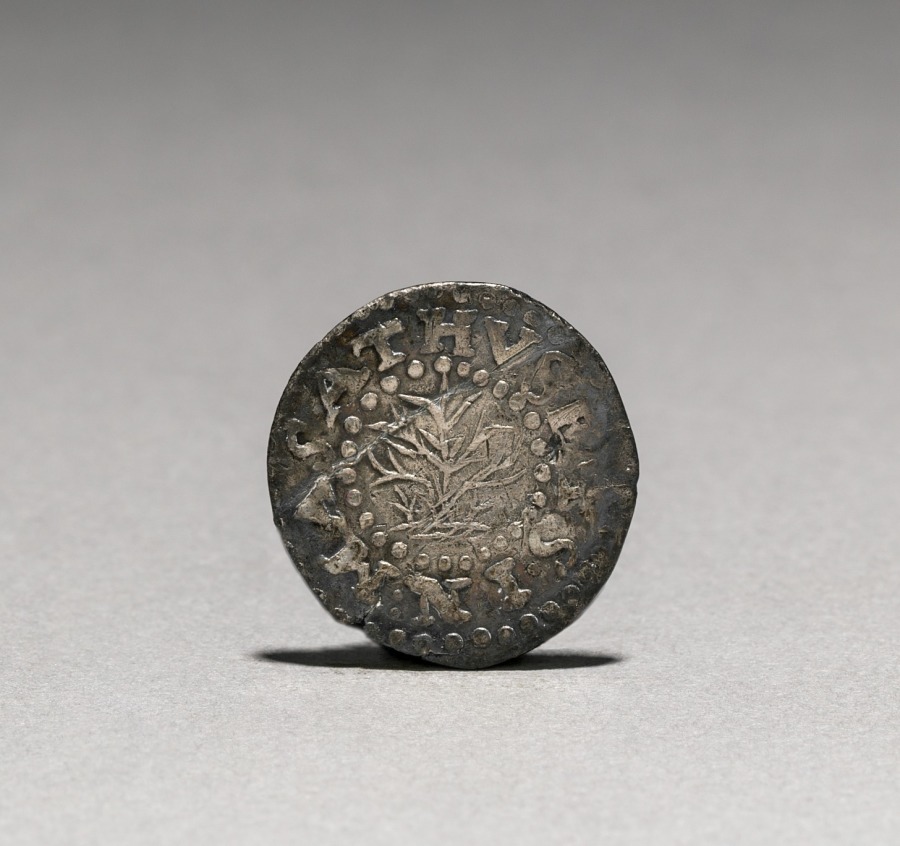
Oak Tree Two Pence (obverse)
✦ Read about this
The Oak Tree Two Pence was struck in defiance of English law: colonial Massachusetts had no royal authority to mint coins, but the Massachusetts Bay Colony began producing its own silver currency in the 1650s and 1660s to address a chronic shortage of coinage.
This small silver piece—just 1.5 centimeters across—was made in 1662 by John Hull (1624–1683) and Robert Sanderson (1609–1693), who together ran the colony's mint in Boston. Hull served as the colony's mintmaster, and the partnership produced the earliest silver coinage in British North America.
The coin belongs to a series named for the tree designs stamped on the obverse, including pine, willow, and oak. This example is part of the collection of the Cleveland Museum of Art, given by Hollis French in 1940.
Background drawn from Cleveland Museum of Art & Wikipedia
Today's poem
I Wandered Lonely As A Cloud
I wandered lonely as a cloud That floats on high o'er vales and hills, When all at once I saw a crowd, A host, of golden daffodils; Beside the lake, beneath the trees, Fluttering and dancing in the breeze. Continuous as the stars that shine And twinkle on the milky way, They stretched in never-ending line Along the margin of a bay: Ten thousand saw I at a glance, Tossing their heads in sprightly dance. The waves beside them danced, but they Out-did the sparkling leaves in glee; A poet could not be but gay, In such a jocund company! I gazed—and gazed—but little thought What wealth the show to me had brought: For oft, when on my couch I lie In vacant or in pensive mood, They flash upon that inward eye Which is the bliss of solitude; And then my heart with pleasure fills, And dances with the daffodils.
William Wordsworth · Public domain
✦ Read about this
William Wordsworth helped launch the Romantic Age in English literature through his 1798 collaboration with Samuel Taylor Coleridge, *Lyrical Ballads*. As one of the central English Romantic poets, his work prized natural settings and personal feeling, qualities on full display in "I Wandered Lonely As A Cloud."
The poem is built in four six-line stanzas, each rhyming ababcc, and moves from a remembered scene to its lasting effect. The speaker recalls coming upon a vast field of daffodils beside a lake, "fluttering and dancing in the breeze," and compares them to the stars of the Milky Way stretched in a "never-ending line."
The closing stanza shifts from the original sight to memory itself: the daffodils return to the speaker's "inward eye" in quiet or pensive moods, filling the heart with pleasure. The poem is finally about how an encounter with nature becomes a renewable source of joy through recollection.
Background drawn from PoetryDB & Wikipedia