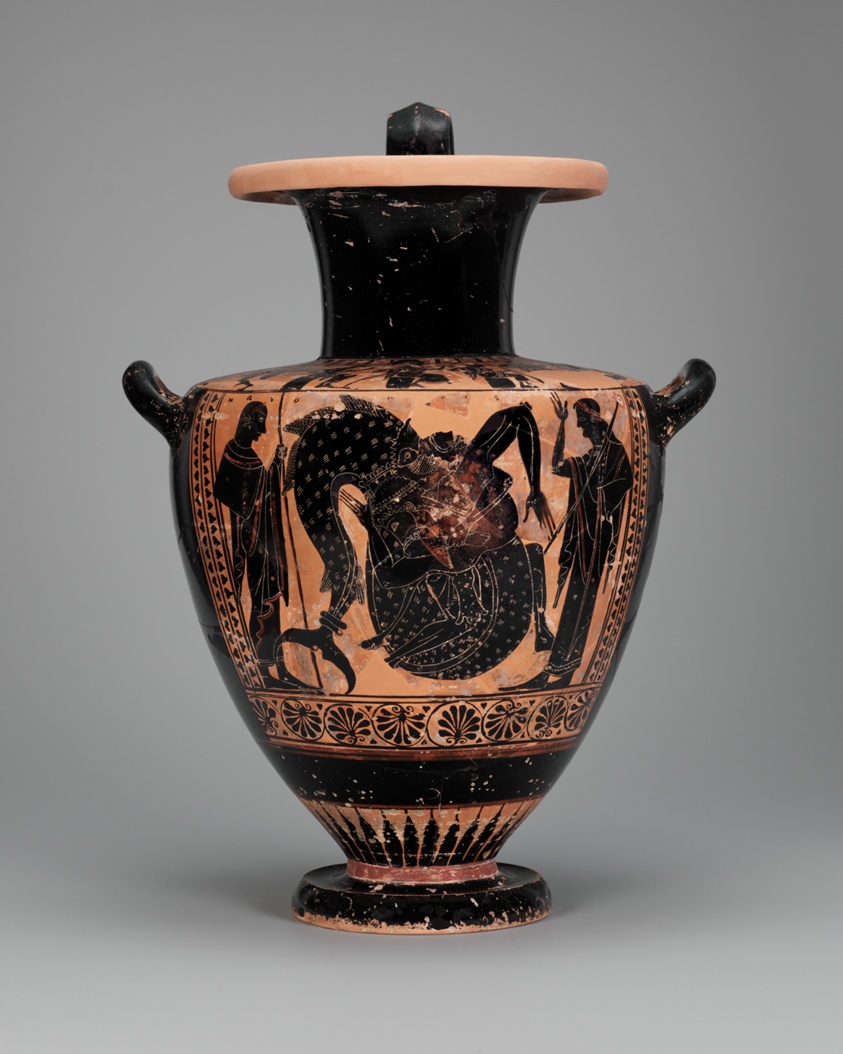
Hydria (Water Jar)
✦ Read about this
This large handled jar held the water used to dilute large quantities of wine in preparation for the Greek symposium. It was considered uncivilized for a Greek to consume undiluted wine, so water was fetched from a public fountain house in a jar like this one. The horizontal handles made it easier to carry, while the vertical handle at the back was used for pouring. On the front of this vase, the hero Hercules wrestles Triton - the messenger of the sea who is depicted as a merman - as a man and a woman look on. They are likely Nereus and Triton's mother Amphitrite, but we cannot be certain. The intricate composition has the Greek hero astride the monster, his arms locked around Triton's neck in an implacable grip, while Triton flails his arms, black fingers stretched against the red background. They face different directions-Herakles to the viewers' right and up, victorious, and Triton to the left and down, vanquished. Precise incision renders the outline and details of the lion skin that Herakles wears, as well as the contour and detail of Triton's scales and fins. Above this scenethe artist has written kalo[s]p[u]this – or "Pythis [is] beautiful"; exactly who Pythis is is another mystery. On the shoulder of the vessel, the area above the front scene on the flat surface between the handles, another mythological scene plays out. This time it is the judgement of Paris, in which the handsome youth must judge a beauty contest between three goddesses - Aphrodite, Hera and Athena (shown seated). Aphrodite famously wins the contest by promising Paris the love of the most beautiful woman in the world. The woman in question turns out to be Helen of Troy, whose love affair with Paris would set in motion the deadly Trojan war.
Background drawn from Art Institute of Chicago
Today's poem
Peace
When will you ever, Peace, wild wooddove, shy wings shut, Your round me roaming end, and under be my boughs? When, when, Peace, will you, Peace? I'll not play hypocrite To own my heart: I yield you do come sometimes; but That piecemeal peace is poor peace. What pure peace allows Alarms of wars, the daunting wars, the death of it? O surely, reaving Peace, my Lord should leave in lieu Some good! And so he does leave Patience exquisite, That plumes to Peace thereafter. And when Peace here does house He comes with work to do, he does not come to coo, He comes to brood and sit.
Gerard Manley Hopkins · Public domain
✦ Read about this
Gerard Manley Hopkins was an English poet and Jesuit priest whose reputation rests almost entirely on work published after his death; he is now counted among the leading English poets. His chief technical innovation was sprung rhythm, a metrical system that broke from conventional Victorian patterns, and he is known for vivid imagery and nature used in praise of God.
"Peace" shows these features in miniature. The poem addresses Peace directly, figuring it as a "wild wooddove" that roams but will not settle, and asks when it will finally rest "under be my boughs." Its compressed syntax, heavy alliteration, and irregular rhythm are characteristic of Hopkins's style.
The poem turns on a religious argument: true peace is impossible while "alarms of wars" remain, but God leaves Patience in its place, and when peace does come it brings work rather than mere comfort—"he comes to brood and sit," not "to coo."
Background drawn from PoetryDB & Wikipedia