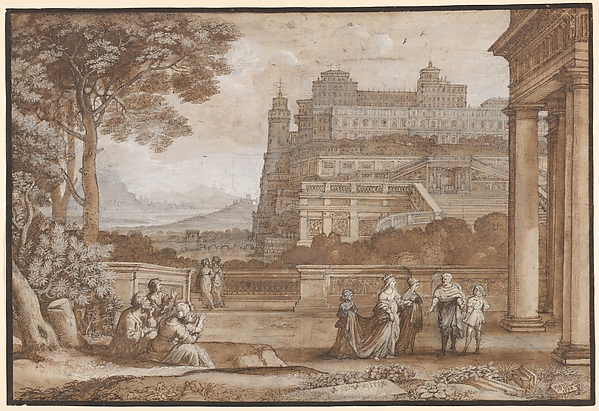
Queen Esther Approaching the Palace of Ahasuerus
✦ Read about this
Claude Lorrain, born around 1604–5 in the Lorraine village of Chamagne, spent nearly his entire career in Rome, where he became the most influential landscape artist of the seventeenth century. This drawing, made in 1658, treats a biblical subject—the Old Testament queen Esther approaching the palace of the Persian king Ahasuerus—as an occasion for an expansive architectural and landscape setting.
The sheet combines several techniques: pen and brown ink, brush and brown wash, and white heightening, all worked over a preliminary sketch in black chalk. The layered media allowed Claude to model light and atmosphere across the broad composition, which measures roughly 30 by 44 centimeters.
The drawing entered the Metropolitan Museum of Art in 1997 through a purchase made possible by the Annenberg Foundation, and is held in the Department of Drawings and Prints.
Background drawn from The Met
Today's poem
Songs of Innocence: Introduction
Piping down the valleys wild, Piping songs of pleasant glee, On a cloud I saw a child, And he laughing said to me: "Pipe a song about a Lamb!" So I piped with merry cheer. "Piper, pipe that song again;" So I piped: he wept to hear. "Drop thy pipe, thy happy pipe; Sing thy songs of happy cheer!" So I sang the same again, While he wept with joy to hear. "Piper, sit thee down and write In a book, that all may read." So he vanish'd from my sight; And I pluck'd a hollow reed, And I made a rural pen, And I stain'd the water clear, And I wrote my happy songs Every child may joy to hear.
William Blake · Public domain
✦ Read about this
William Blake was an English poet, painter and printmaker who went largely unrecognised in his lifetime but is now considered a seminal figure of the Romantic Age. He spent almost his entire life in London, except for three years in Felpham, and produced a symbolically rich body of work that treated the imagination as "the body of God" or "human existence itself."
This poem opens Blake's "Songs of Innocence," and its five quatrains stage the act of creation that the collection performs. A piper meets a laughing child on a cloud who directs him first to pipe, then to sing, then to write his songs in a book "that all may read." The child vanishes, and the speaker fashions a rural pen from a hollow reed to set down his "happy songs."
The shift from piping to singing to writing dramatises the move from spontaneous music to fixed text, framing the songs as artless verses meant for every child to hear.
Background drawn from PoetryDB & Wikipedia