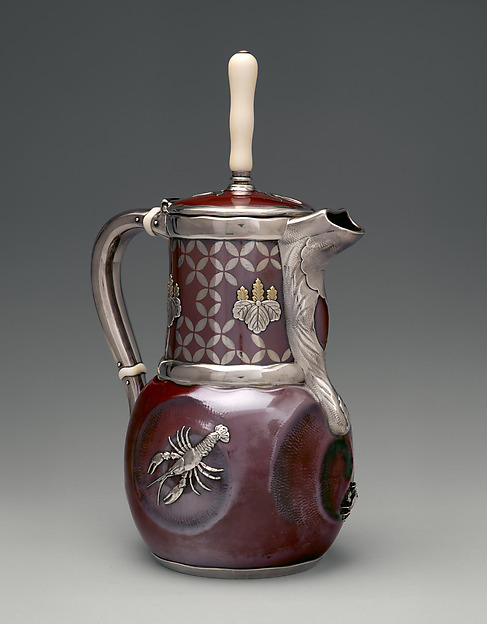
Chocolate Pot
✦ Read about this
This chocolate pot, made by Tiffany & Co. in 1879, combines silver with patinated copper, gold, and ivory—a mixed-metal palette that reflects the firm's interest in Japanese metalworking techniques during this period. Rather than the uniform polished silver typical of American tablewares, the surface plays warm copper and gold against silver, departing from Western conventions.
Tiffany & Co. was founded in New York in 1837 and grew into one of the United States' preeminent makers of silver and jewelry. By the late 1870s the firm was producing artistically ambitious decorative objects, and its mixed-metal wares of this era were among its most innovative.
The pot stands roughly 11 5/8 inches tall and was made for serving chocolate, then a fashionable beverage. It was acquired by The Metropolitan Museum of Art in 2017 for the American Wing, through gifts from the Louis and Virginia Clemente Foundation and Emma and Jay A. Lewis.
Background drawn from The Met & Wikipedia
Today's poem
What Being in Rank-Old Nature
What being in rank-old nature should earlier have that breath been That hйre pйrsonal tells off these heart-song powerful peals?— A bush-browed, beetle-brуwed bнllow is it? With a soъth-wйsterly wнnd blъstering, with a tide rolls reels Of crumbling, fore-foundering, thundering all-surfy seas in; seen Ъnderneath, their glassy barrel, of a fairy green. . . . . . . . . Or a jaunting vaunting vaulting assaulting trumpet telling
Gerard Manley Hopkins · Public domain
✦ Read about this
Gerard Manley Hopkins was an English poet and Jesuit priest whose reputation rests entirely on posthumous publication; he is now counted among the leading English poets. His central technical innovation was sprung rhythm, a metrical system that this poem demonstrates clearly, with stresses falling heavily and irregularly rather than in conventional regular feet.
The text is unfinished, breaking off mid-thought after a line of dashes. Its heavily stressed syllables, marked accents, and dense alliteration ("bush-browed, beetle-browed billow," "jaunting vaunting vaulting assaulting") are characteristic of Hopkins's experimental style and his attempt to render the energy of natural forces in sound.
The poem turns on a question: what kind of being or breath could produce these "heart-song powerful peals"? It answers through images drawn from nature — a great billow driven by a south-westerly wind, crumbling and thundering surf, the glassy green underside of a wave — reflecting Hopkins's habit of praising creation through vivid, particular natural imagery.
Background drawn from PoetryDB & Wikipedia